Tag: choosing a school

  • Best full boarding schools in the UK: how to find one

    In short. The best full boarding schools in the UK are the ones where most pupils stay in at weekends, with a real Saturday and Sunday programme, matches, activities and a house that stays alive. The word “boarding” on the label does not prove any of that. Verify it by asking a school its actual weekend occupancy and what a Saturday night looks like in the house.

    A boy from Hong Kong lands in September, unpacks, and has a good first week. Lessons, a games afternoon, new names over supper. Then Friday comes. By six o’clock the corridor is quiet. Doors that were open all week are shut. The two other boys who live nearby have gone home, and the houseparent is running a skeleton weekend for the handful left behind. He is thirteen, six thousand miles from his own bed, and the building he was told would be his home has gone half dark for two days.

    Nobody lied to him. The school does board. It just boards less than the brochure implied, and the gap between “we have boarders” and “the house is full on a Saturday” is the single most important thing an overseas family can get wrong.

    Why “boarding” on the label proves nothing

    Plenty of schools describe themselves as boarding schools and mean it in a narrow sense. They have beds. They have boarders. What they may not have is a weekend.

    Boarding in Britain runs along a spectrum. At one end sits genuine full boarding, where the great majority of pupils are in on a normal weekend and school life simply continues through Saturday and Sunday. At the other end sit schools that are mostly day, with a boarding house attached, where the boarders themselves largely go home or to guardians from Friday afternoon. Between the two sits weekly and flexi boarding, built around pupils who sleep at school in the week and leave at the weekend by design. Each of these can be an excellent school. Only one of them is the right shape for a child who cannot go anywhere.

    The risk to check for is a specific one. A school can be full of boarders on a Wednesday and close to empty on a Saturday, because a large share of them live within an easy drive and treat the place like a weekly boarding school even when it is not sold as one. For a British family forty minutes away, that pattern is a feature. For a family in Lagos or Shanghai, it is the thing that leaves their child among a thin weekend crew, and it is almost never printed anywhere you can read it. You have to ask.

    If the difference between these models is new to you, our piece on what full boarding actually means sets out the definitions, and full boarding versus weekly boarding walks through who each one suits.

    What a genuine full boarding school looks like

    Real full boarding is easy to recognise once you know what you are looking at, because the school is organised around the weekend rather than tolerating it.

    The first sign is simple occupancy. Most pupils are in the house on a normal Saturday and Sunday, not an exeat one. The second is a programme. There are fixtures on Saturday, staff running activities, trips going out, the chapel or assembly still happening, prep still structured. Sunday has a shape to it rather than being a long empty stretch to be survived. The third is the house itself. On a Saturday night a full boarding house has noise in it, common rooms in use, staff and older pupils around, a duty team that is running something rather than minding a near-empty building.

    None of this is about grandeur. A modest school with a full, busy house serves a child far from home better than a famous one that hollows out on Friday. The question is not how impressive the place looks on an open morning. It is whether the ordinary weekend, the one your child will live through forty times a year, is populated and planned.

    A few schools are often mentioned in this context, and it is worth saying how to read that. Gordonstoun, on the Moray coast in the north of Scotland, sits in a remote setting with a long tradition of outdoor and expeditions education. Sedbergh, in the Cumbrian fells, has a long-standing sporting and boarding tradition. We offer these as illustrations of the kind of school worth a look, not as a ranking and not as a claim about any school’s current weekend numbers. With any school on your list, ask the concrete questions: how many boarders typically stay on site at a normal weekend, what Saturday and Sunday actually involve, and how often pupils go home. The point is the shape, not the name.

    How to test the claim on a visit and in the data

    Sales copy will not tell you weekend occupancy. Direct questions will. Ask them plainly, and pay as much attention to how a school answers as to what it says.

    On a visit, ask the houseparent, not the admissions office, what a Saturday night in the house actually looks like. Ask how many of their boarders are in on a normal weekend, and press gently past the first cheerful answer to a real proportion. Ask what is laid on for a full boarder on a Sunday afternoon in November, when the weather is bad and nothing is going wrong. Ask whether there are weekend exeats built into the calendar and how many, because a school with frequent exeats is telling you something about how full its weekends really are. A confident full boarding school answers all of this without flinching, often before you finish the question. A mostly-day school with a boarding house tends to get vaguer the closer you get to Saturday.

    In the data, look at the boarders-to-day-pupils ratio and at the weekly-versus-full boarding split if the school publishes it. A school that is overwhelmingly day, with a small boarding minority, is structurally more likely to quiet down at weekends, whatever the label. Ask directly for the share of boarders who stay in on a non-exeat weekend. If a school cannot or will not give you a number, that reticence is itself an answer. Do not accept an invented figure and do not let anyone, including us, hand you one. Get it from the school, in writing if you can.

    If a placed child is quietly struggling at weekends

    Even at a genuinely full house, some children find the weekends hardest, and the signs are easy to miss from another time zone. Watch for a child who goes quiet on Sunday calls, stops mentioning weekend plans, or describes the house as “empty” when you know it is not. None of that means the placement is wrong. It usually means the child needs a job to do and an adult who has noticed. Tell the houseparent directly and ask, by name, who is on duty and what your child did last Saturday. If a child ever sounds frightened, describes being routinely alone, or you cannot get a straight account of their weekend from the school, treat that as a same-day conversation with the housemaster or housemistress, not a wait-and-see.

    Why this matters more than almost any prestige signal

    For a child who can go home most weekends, an empty Saturday house is a minor detail. For a child who cannot, it is close to everything.

    Ranking, name and exam results describe what a school does with its academic intake. They say nothing about whether the building your child sleeps in is a home on the two days a week when the timetable stops holding them. A high league-table position bought at a school that half-empties on Friday leaves an overseas thirteen-year-old with the worst of the deal: a famous name on the fees and a lonely weekend in the reality. The weekend is where homesickness is either absorbed by a busy house or left to sit in a quiet one. It is where friendships either deepen over a Saturday match and a Sunday film or fail to form because everyone scatters. It is, week after week, the largest single block of your child’s actual life at the school.

    This is why we treat full boarding as a threshold question for globally mobile families rather than a nice-to-have. Get it wrong and the best-known offer in the pile becomes the wrong home. Get it right and a less celebrated school with a full, warm, well-staffed weekend can be the making of a child. The label is not the thing. The Saturday night is the thing.

    How to verify a school is genuinely full boarding

    Work through these before you apply, not after your child has moved in. Ask the house, not the brochure.

    • Weekend occupancy. What proportion of boarders are in the house on a normal, non-exeat weekend? Ask for a real figure, from the school, and be wary of any refusal to give one.
    • Saturday programme. Are there fixtures, staffed activities and structured prep on Saturday, or does the week simply stop?
    • Sunday shape. What is actually laid on for a full boarder on a wet Sunday afternoon in term, with nothing wrong and nowhere to be?
    • Who is there on Sunday. How many pupils and how many staff are around, and is the duty team running something or minding an empty building?
    • Boarders versus day pupils. What is the ratio, and what share of the boarders are full rather than weekly or flexi? A small boarding minority is a warning to dig further.
    • Exeats and closed weekends. How many exeats are built into the calendar, and does the house stay open and staffed every other weekend?
    • The houseparent’s ease. Did the person who runs the house answer the weekend questions readily, or did the answers get vaguer the closer you got to Saturday night?

    Two clear answers you trust, occupancy and Saturday programme, tell you more than any ranking on the list.

    The best school for your child is the one whose ordinary weekend you would be happy to leave them in. Ask what Saturday night looks like, believe the answer you are given rather than the one you hoped for, and let a full house, not a famous one, be the thing that decides.
  • Boarding schools for dyslexia: what real support looks like

    In short. There is no reliable ranked list of the best boarding schools for dyslexia in the UK, and provision is very hard to verify from the outside. What decides it is the depth of the learning-support department, whether specialist teachers are on staff, whether the whole school knows, and whether exam access arrangements are routine. Judge the provision, not the prospectus.

    A father reads the same sentence on the ninth website of the evening. “We are proud to support pupils with dyslexia and specific learning differences.” It is warm and reassuring. It tells him nothing. He has a son who is bright, funny, and two years behind where his reading should be, and he cannot tell whether this school would carry his boy or quietly lose him.

    He is right to be uneasy. That sentence sits on almost every prospectus in the country, and what it means varies wildly from one school to the next. The gap between the words and the room is where children get missed.

    Why there is no list of the “best” schools for dyslexia

    You will search for a ranking. You will not find an honest one, because the thing that matters most about SEN provision is close to invisible from outside the school.

    A league table measures exam results, which is mostly a measure of who a school admits. Learning support does not show up in any public dataset. Two schools can print the same paragraph, hold the same accreditation, and run support that is worlds apart in practice. One has a proper department with specialist teachers who shape what happens in every classroom. The other has one part-time tutor and a withdrawal room.

    So a ranked list of the best boarding schools for dyslexia is selling you a comfort, not a fact. What helps is knowing how to read a school’s provision for yourself, then confirming it directly with the people who live inside it.

    The honest problem: “we support dyslexia” can mean almost nothing

    Here is the trap. A prospectus says the school supports dyslexia. A parent hears a specialist department, trained staff, and a plan. The school, in some cases, means a weekly withdrawal lesson: the child is taken out of a normal class once a week, given some study skills, and returned to classrooms that carry on as before.

    That is not nothing. For a mild difficulty it may even be enough. But for a child whose dyslexia shapes how they read, write, and remember every hour of the day, one lesson a week against thirty-something that do not change is a leak, not a fix. Your job is to make the school tell you what sits underneath the word.

    What real provision actually looks like

    Strip away the brochure and genuine provision has a recognisable shape. Look for most of these, not one of them.

    A staffed learning-support department, not a single overstretched person. Ask how many specialists there are and how many pupils each one holds.

    Specialist teachers, not willing generalists. The standard to look for is staff with a recognised qualification in specific learning difficulties, an assessment-level or teaching-level SpLD certificate. A kind teacher who has read a leaflet is not the same as a trained one.

    Whole-school awareness. The real test is the ordinary classroom, not the support room. Do subject teachers know which children are dyslexic and change how they teach and mark? Provision that lives only in the withdrawal room and dies at the classroom door is the weak kind.

    Assistive technology treated as normal. Laptops, text-to-speech, speech-to-text, audiobooks. In a school that has thought about this, a child using a laptop to write is unremarkable. In one that has not, it is a fuss every time.

    Exam access arrangements as routine. Extra time, a reader, a scribe, a word processor, a separate room. These have to be assessed for and applied for in advance. A good department runs the process quietly and early. Ask whether they do it in-house and how many pupils currently hold arrangements.

    No stigma. This is the quiet one, and it matters as much as any of the above. In the right school, needing support is ordinary and no one is labelled by it. In the wrong one, the “learning-support kids” are a category, and children learn to hide their difficulty rather than use the help. A child who is ashamed will not walk into the room that could help them.

    Mainstream with strong support, or a specialist SEN school?

    This is the fork most families miss, and it changes everything.

    A mainstream boarding school with a strong learning-support department teaches a full ability range and folds support around children who need it. For a child with mild to moderate dyslexia who is bright and otherwise keeping up, this is often the right home: they stay in the mainstream, stretched by able peers, with the support running underneath them.

    A specialist school, built around specific learning difficulties, is a different thing. The whole institution is designed around how these children learn: smaller classes, specialist teaching in every lesson, therapy woven in. For a child whose dyslexia is severe, or who arrives already bruised by years of being the one who could not keep up, a mainstream department, however good, may not be enough. The specialist setting can be the difference between a child who recovers and one who keeps drowning quietly.

    Neither is better in the abstract. The question is your particular child: how severe is the difficulty, and how much of their confidence is already spent? A mild reader with fight left in them and a severe one who has stopped putting their hand up need different rooms. Be honest about which you have.

    How to triangulate beyond the school’s own answer

    Never take the provision at face value from the people whose job is to fill the beds. The admissions office will always say yes. Verify it from angles they do not control.

    Talk to current SEN families. Ask the school to connect you with a parent whose child uses learning support. A confident school does this readily. Then ask the real questions: does the support actually happen every week, do subject teachers know, did access arrangements come through on time, does the child feel singled out?

    Ask for specifics, and watch how they answer. A strong department answers with numbers and named processes. A weak one answers with warmth and adjectives. “We really care about every child” is not an answer to “how many specialist staff do you have?”

    Ask to meet the head of learning support, not just admissions. The person who runs the department will tell you more in ten minutes than the prospectus does in ten pages. If the school will not put you in front of them, that is itself a piece of information.

    Confirm, do not assume. If a school’s materials do not make the provision clear, treat that as a question to ask directly, never as a verdict.

    Questions that reveal real dyslexia and SEN support

    Use these on a call or a visit. The answers, and the ease with which they come, tell you more than any brochure.

    • Department size: How many learning-support specialists do you employ, and how many pupils does each one work with?
    • Specialist staff: Are your support teachers qualified in specific learning difficulties? Which qualification, and do you have assessors on staff?
    • Whole-school reach: How do subject teachers know a child is dyslexic, and what do they change in the ordinary classroom because of it?
    • Access arrangements: Do you assess for exam access arrangements in-house? How early, and how many pupils currently hold them?
    • Assistive technology: What tech do dyslexic pupils use day to day, and is a child on a laptop unremarkable here?
    • Delivery, honestly: Is support mostly a weekly withdrawal lesson, or does it run through the week and into subject teaching?
    • Culture: How do you make sure a child is not embarrassed to use support? Can I speak to a current family who uses it?
    • Cost: Is learning support included in fees or charged separately?

    The child who is missed quietly

    Picture the one who slips through. Not the child who acts out. The one who goes quiet. They hand in less. They say the work is boring, because “boring” is easier to admit than “I cannot read this fast enough.” A school that means well but is not set up for them will call them lazy, or a late developer, or fine, and a term goes by, then another. That is the failure to fear, and it is silent.

    Which is why, when a school gives you a smooth, reassuring answer about dyslexia support and something in you is not convinced, you should trust your own read. You know whether your child is the sort to hide a difficulty until it becomes a crisis. A polished answer from an admissions office is not evidence. Your instinct, formed over years of watching this child, usually is.

    If your child is already struggling

    A learning difficulty that is missed does not stay still, it compounds. Treat these as act-now, not wait-and-see: a child who has stopped trying and calls themselves stupid, who is anxious or tearful about school work, withdrawing from friends, not sleeping, or masking so hard that no one sees the effort it costs. Ask the school, in writing, for the named specialist responsible for your child, a written support plan, and a review date. If the plan is vague or slow, escalate above the housemaster to the head of learning support and the deputy head. A child quietly falling behind is a different situation from one who needs a fortnight to settle, and it deserves a faster, firmer response.

    The best school for a child with dyslexia is not the one with the finest sentence in its prospectus. It is the one that can show you the department, the staff, and the families behind the word, and that your own read tells you will keep your child known.

  • Boarding schools near London vs deep in the country

    In short. A boarding school’s setting shapes its daily feel as much as its crest does. Schools near London tend to feel busier and more outward-facing, with day pupils and city access close by. Schools an hour or two out feel more self-contained, with more of a child’s life happening on site. Neither is better. Choose the setting that fits your child, not the postcode that impresses.

    Two schools sit on the father’s screen, an hour apart by road. On paper they match. Similar size, similar fees, the same photographs of children on the same green lawns. He has been told both are good, and both are. What no one has told him is that they will not feel the same to his son, and the reason is nothing on the prospectus. It is where they stand.

    One is close to London, ringed by towns and stations. The other is an hour or two out, with fields on every side. That gap of sixty minutes will shape his son’s Saturdays, his friendships, and how far away home feels on a wet Sunday in November.

    Why an hour on the map changes the feel

    Setting is not scenery. It decides who is in the building at the weekend, how easily a child can reach a city, and how much of their life happens inside the school gates.

    A school near London tends to draw day pupils from the surrounding towns, and in our experience many go home on Friday. The city is a train ride away, so exeats and visiting parents are simple to arrange. The school faces outward, toward the world beyond it.

    A school deep in the country cannot lean on a nearby city. It has to be the world. More pupils board, fewer go home at weekends, and the school builds a full life on site because there is no easy alternative. The gates hold more of the week.

    Same crest, same fees, a very different daily experience for the child living it.

    Schools near London: the connected setting

    Near London, and across the commuter belt, boarding tends to feel busier and more porous. Day pupils and boarders mix, the weekend has more coming and going, and the wider world sits close.

    The strengths are real. A child who needs the city near them, who wants to see a parent passing through, who thrives on access and movement, breathes more easily here. Reaching an airport is quick, which matters when you are flying a child in and out from overseas. In our view the trade is that weekends can be quieter for full boarders when local families go home, and the boarding community can feel less like a single, self-contained world.

    Schools deep in the country: the contained setting

    An hour or two out, the feel changes. With fewer day pupils and a smaller pull from any city, more of the pupils’ whole life happens on site. Saturdays are full. The boarding house is the centre of things, not a base between trips home.

    For the right child, in our view, this is the stronger setting. The boarding heart can feel fuller and the community more complete, and there is space and open countryside that a school hemmed in by a town cannot offer. In our view a child eight time zones from home may be better held by a place where the weekend does not empty out. The trade is distance. Exeats take longer, the nearest airport is further, and a spontaneous visit from a passing parent is harder to arrange.

    Four schools, four settings

    It helps to make this concrete. What follows are our impressions of four well-known schools, chosen only to show how setting changes the feel. This is not a ranking, and none is being held above another.

    Oundle, in Northamptonshire, is woven into its market town; school and town share the same streets. In our view it reads as a strong full-boarding community set out in the country; families should confirm current boarding patterns directly.

    Bryanston sits on a large rural estate in the Dorset countryside. In our view it has an individual and creative character, and its setting gives it the room to be its own world.

    Malvern College stands against the Malvern Hills in Worcestershire, a classic country boarding setting with the hills at its back.

    Among these, Winchester College sits at the connected end of the spectrum. An ancient and academic school in the cathedral city of Winchester, in Hampshire, it sits closer to London and within easier reach by road and rail, though families should compare actual journey times from home. Its setting shows how proximity can change the feel: the city and the capital are near, and in our view the school faces outward toward them.

    Read those four and the point is not which is best. It is that a school an hour from London and a school two hours out are answering two different questions about how a child should live.

    Near London vs deep regional: the trade-offs

    What changes Near London / commuter belt Deep in the country (1 to 2 hours out)
    **Weekend feel** Busier and more mixed. Some day pupils and local boarders go home on Friday, so the building can quieten. Fuller on site. More pupils stay, so Saturdays and Sundays have a shape of their own.
    **Access to a city** Close. Trips out and visits are quick, and an airport is usually within easy reach. Further. The nearest city and airport take longer, so outings need more planning.
    **Boarding community** More outward-facing. The wider world sits close, so the house is one part of a bigger day. More self-contained. The house is the centre, and the boarding heart tends to feel fuller.
    **Travel and exeats** Simpler. Shorter journeys home and back, and easier for a parent passing through to see the child. Longer. Exeats and half-term travel take more time and planning, especially from overseas.
    **Which child it suits** A child who needs the world close: access, and a familiar face within reach. A child who thrives in a contained community: same faces all week and a full life on site.

    Which setting suits which child

    Start with the child, not the map.

    Some children need the world close. They settle better when a city, an airport and a familiar face are within easy reach. Movement steadies them. For them, a connected school near London is not a compromise, it is the right fit, and the busier, more porous weekends are a feature rather than a cost.

    Other children thrive in a contained community. They put down roots when the same faces are around them all week, when Saturday is full on site, when the school is a whole world rather than a staging post. For them, a school deep in the country gives the fuller boarding life, and the longer journey home is a price worth paying.

    Neither child is braver or better. They are simply different, and the setting that would settle one might unsettle the other. This is why the postcode that impresses the family at dinner is the wrong place to start. The question is not which setting sounds best. It is which one your particular child would live well inside.

    Where this leaves the two schools on the screen

    The father with two schools an hour apart is not really choosing between two prospectuses. He is choosing between two kinds of week for his son. One faces the city; one faces inward and fills its own weekends. Both can be excellent. Only one will fit the boy he knows.

    Setting shapes a child’s daily life as much as any crest or league position. Choose the feel that fits your child, and let the postcode come last.

  • Faith schools, explained — what a religious foundation actually means for your child

    Faith schools, explained — what a religious foundation actually means for your child

    In short. Most UK boarding schools with a religious foundation — Church of England, Catholic, Methodist, Quaker — are far less devotional in daily life than the label suggests, and far more shaped by it in quieter ways: the values taught, the pastoral tone, and often the calendar. A faith foundation is rarely a reason to rule a school out, even for families of a different faith or none. It is a detail worth understanding, not fearing.

    An international parent sees “Church of England foundation” on a school’s site and pictures chapel every morning, hymns before breakfast, a headmaster in a dog collar. For a handful of schools that is close to true. For the great majority, it is not. Understanding the gap between the label and the daily reality is the whole point of this piece.

    What “faith foundation” usually means in practice

    Most religiously founded boarding schools in the UK were established by a church, an order, or a denomination — often a century or more ago — and have kept that identity as part of their history and ethos, not as a daily requirement of belief. In practice, that typically means:

    • A weekly, not daily, act of worship. A chapel service once a week, often on Sunday evening, attendance sometimes compulsory and sometimes not. Daily prayers, where they exist, are frequently a short, inclusive moment rather than a devotional service.
    • Religious education as an academic subject, taught critically and comparatively — world religions, ethics, philosophy — rather than as instruction in one faith.
    • A pastoral tone shaped by the tradition, even where the practice is not. Quaker schools, for instance, tend to run quieter, more consensus-based pastoral systems, a legacy of the tradition rather than an act of worship.
    • A calendar built around the tradition’s key dates — a carol service, a founder’s day rooted in a saint’s day — treated as much as school tradition and community occasion as religious observance.

    Does my child have to be that faith?

    Almost never, and this is the detail that puts most international parents at ease once they hear it plainly. The large majority of faith-founded boarding schools admit pupils of any faith or none, and increasingly the boarding population is genuinely mixed — Christian, Muslim, Hindu, Jewish, non-religious, sitting in the same house. What is usually expected is participation in the school’s communal life, including chapel attendance as a shared occasion, in the same way a non-religious family might join a carol concert without it being a statement of belief.

    A small number of schools are more observant than this and say so clearly — daily compulsory chapel, religious studies with a confessional slant, a headteacher who is also a serving cleric. These are the exception, not the rule, and they are usually upfront about it rather than something you discover on arrival.

    What it is not usually a signal of

    It is worth separating faith foundation from two things it is often, wrongly, assumed to predict:

    • It is not usually a signal of academic rigidity or conservatism. Many of the UK’s most academically ambitious and forward-thinking schools have a religious foundation that shows up mainly in the school song and the chapel roof.
    • It is not usually a barrier for a family of a different faith. Muslim, Hindu and Jewish families board at Christian-foundation schools in significant numbers, often specifically choosing a school for its pastoral reputation despite, not because of, the label.

    What is genuinely worth asking

    If a school’s religious character matters to you — whether because you want more of it or want to be sure there is not more than you expect — a short, direct set of questions gets you a real answer faster than the website will:

    • How often is chapel or worship compulsory, and what happens for a pupil who asks not to attend?
    • Is religious education taught as belief or as a comparative academic subject?
    • What proportion of the current boarding house is a different faith or no faith, and how is that managed day to day?
    • Is there a prayer room or equivalent provision for pupils of other faiths?

    The honest bottom line

    A faith foundation on a UK boarding school’s history page is, for the overwhelming majority of schools, a description of heritage and tone — not a devotional requirement your child will be asked to meet. It is worth understanding rather than filtering out on sight, and worth asking about directly rather than assuming from the name. The school that says “Church of England foundation” and the school that means daily chapel and confessional RE are not the same kind of place, and five minutes of direct questions will tell you which one you are looking at.

  • Seven types of child, and the school each one needs

    Seven types of child, and the school each one needs

    You can usually tell before the tour ends. One child makes straight for the boathouse and barely looks at the science block. Another asks the head three questions about the debating society and none about the food. The prospectus you came to read is already beside the point. Children show you who they are.

    We keep meeting the same seven types. Naming the one or two that fit your child is the quickest way to see which schools belong on your list, and which ones never did. Here they are, how to spot each, and what the right school looks like once you have.

    What are the seven types of child?

    They are patterns, not labels. Most children are a blend of two, and the blend is the useful part. A child who is both a Thinker and an Explorer wants a different school from one who is a Thinker and a Quiet Observer, even though both love ideas.

    Type You’ll recognise them by What the right school has Read more
    The Builder Takes things apart, codes for fun, wants to know how it works Real labs, design and engineering, a route to a startup or a research group The Builder
    The Artist Lives for the studio, the stage, the instrument Serious conservatoire and portfolio pathways, not art as a reward for finishing the real work The Artist
    The Thinker Reads the next chapter unasked, argues because they’ve thought about it Breadth, debate, teachers who feed a mind that is already ahead The Thinker
    The Athlete Happiest on the pitch, the water, the track Sport as a development pathway with real coaching, not a Wednesday afternoon The Athlete
    The Explorer Curious past the border, wants the language and the exchange Genuine international programmes, the IB, exchanges that actually travel The Explorer
    The Quiet Observer Reflective, deep focus, needs room to think Small classes, careful pastoral care, a place that notices the quiet ones The Quiet Observer
    The Networker Warm, makes friends everywhere, thrives on belonging A small, close-knit school where everyone is known by name The Networker

    How do you tell which type your child is?

    Watch what they do when no one is setting the task. The type shows up in the unstructured hour, not the timetabled one. The child who fills a free afternoon with a half-built machine is telling you something the exam results won’t.

    Listen to what they complain about, too. A Thinker complains of boredom when the work is easy, not when it’s hard. An Athlete goes flat without a season to train for. A Quiet Observer comes home drained by a school that never stops. The frustration points at the type as clearly as the enthusiasm does.

    And ask them. Older children often know exactly which two of the seven they are, once you show them the list. Younger ones need you to read it for them, from the evidence of an ordinary week.

    Most children are two types, not one

    Here is the mistake worth avoiding: forcing a child into a single box. Real children are combinations. A Builder who is also a Networker will wilt in a brilliant, cold, individualist school and come alive in a warm one with a good workshop. The second type is often the one that decides fit, because it tells you about the environment rather than the subject.

    So pick two. The pair describes your child more honestly than either alone, and it does more work when you start comparing schools.

    Why does the type change the school?

    Because the same school is a gift to one child and a slow disappointment to another, and the league table cannot tell you which. Rankings reward selectivity and exam output. They are silent on whether a talented Artist will be taken as seriously as they take themselves, or whether a Quiet Observer will be seen at all in a big, loud, high-achieving house.

    The biggest mistake we see international families make is choosing the school before they have understood the child. Prestige is the wrong first question. The right first question is who your child is, because that is the thing the prospectus can’t answer and the thing that decides whether five years abroad build them or bruise them.

    Read the child, then read the school. In that order the shortlist gets shorter and better on the same afternoon.

    How to use your child’s type on Boardingly

    Every school on Boardingly carries a Worldly Ranking, our view of how well a school develops a child ready for the world. When you add your child’s type to their profile, the recommendations stop being generic and start being theirs. An Athlete sees the schools where sport is a real pathway. An Explorer sees the ones with genuine international depth.

    Add up to two types to your child’s profile and the matching sharpens straight away. It takes a minute, and it changes what you see first.

    Add your child’s type to their profile →

    Not sure where to start? The Boardingly Worldly Approach explains the seven types and the eight things we measure in every school.

    Frequently asked questions

    Can a child be more than two types?
    They can lean toward several, but two is the useful limit. Picking your child’s strongest two keeps the recommendations sharp. A longer list waters them down.

    My child seems to have changed. Should I update the type?
    Yes. Children grow into and out of types, especially between 11 and 16. Revisit the profile when the evidence of an ordinary week changes.

    Does the type override the academic side?
    No. Academic strength is built into every school’s Worldly Ranking already. The type sits on top, to match your child to the environment, the pathway and the pastoral fit that the ranking alone won’t capture.

    We’re applying from overseas. Does the type still help?
    It helps more. When you can’t visit six schools in a term, a sharper shortlist saves the trips that matter for the ones worth taking.

    Start with the child

    A school is not good or bad in the abstract. It is good or bad for a particular child, in a particular pair of types, at a particular age. Start there. The right school is the one that fits the child you have, not the one the league table happens to admire.

    Read the child first. The list gets shorter, and the decision gets easier.

  • Choosing a School for a Child Still Exploring

    Choosing a School for a Child Still Exploring

    In short. Most children aged 11 to 14 have not found their thing yet, and that is normal, not a delay. The right school keeps options open: broad tasters, strong pastoral care, and a culture that lets a child change their mind. For an undecided child, breadth beats one famous specialism.
    Her daughter came home from an open day quiet in a way that worried her. On the train, the girl finally said it. “Everyone there already knew what they were. There was a boy who had been rowing since he was nine. A girl who plays cello in some orchestra. I just like a bit of everything. I do not have a thing.”
    She is twelve. She is good at most of what she tries and certain of none of it. She reads widely, swims decently, drew a comic over half term, gave up the comic, took up the guitar, keeps the guitar in its case more often than not. Her mother had started to wonder whether this counted as a problem. It does not. It is the most ordinary thing in the world.

    Why “not knowing yet” is the normal setting

    There is a quiet pressure in the boarding-school conversation to arrive already sorted. Brochures photograph the county-level fencer and the child who codes. Parents at the school gates trade specialisms like currency. Somewhere in all of it, the good all-rounder starts to feel like the one who missed the memo.
    They did not miss anything. A child of eleven or twelve is still gathering the raw material that a real leaning is eventually made from. Interests at this age are wide, shallow, and quick to change, and that width is the point. It is how a child works out what they actually care about rather than what they were pointed at first.
    We would call this child an Explorer, on one condition: it is a stage, not a label. No eleven-year-old is one fixed sort of person, and the schools that quietly sort children into types early tend to be the ones a curious child grows out of. The Explorer is simply a child still trying doors. Most of them are. One honest caveat: there is a difference between happily exploring and quietly avoiding. A child who tries nothing, drops everything the moment it gets hard, or has gone flat rather than curious is telling you something else, and that is worth a closer look rather than just a broad school.

    What a leaning actually looks like when it arrives

    When a real interest does surface, it rarely arrives as a single clean category. Children tend to hold two or three leanings at once, and the mix is the interesting part.
    Some drift toward making and figuring out how things work. Give them a design-and-technology workshop, a robotics club, a first line of code, and they light up. Call it a Builder streak. Others come alive outdoors and under a bit of pressure: team sport, the Combined Cadet Force, a Duke of Edinburgh expedition with a heavy pack and a wrong turning to recover from. That is an Athlete and outdoorsperson leaning, and it often sits happily beside the workshop one.
    Then there is the child who needs to make things that mean something, on a stage or a page or in a practice room. And the one who simply wants to argue an idea to its end, who reads past the set text and asks the awkward second question. An Artist thread. A Thinker thread. Most Explorers carry a little of several. The girl on the train might turn out to be a Builder who acts, or a Thinker who climbs. You cannot know at twelve, and you are not meant to.
    The mistake is to buy the labels too early and shop for a school that matches one of them. You would be fitting a school to a child who does not exist yet.

    The one thing worth being firm about

    Here is the position, stated plainly. For a child who has not found their thing, breadth and pastoral depth usually beat a school built around one brilliant specialism. Not always. A specialist school with real beginner pathways and genuine range can suit an Explorer too, because the enemy is a narrow culture, not a specialism as such. But where breadth and a single famous strength genuinely trade off, breadth wins for the undecided child.
    A school famous for rowing, or maths, or music, is superb for the child who already knows they are a rower, a mathematician, a musician. For an Explorer, that same reputation is a narrowing force. The best coaching, the best kit, the strongest peer group all cluster around the one thing, and the culture gently makes the case that the one thing is what matters. A child still looking will either force a fit or feel like a spare part. Neither is what you are paying for.
    Breadth does the opposite. It lets a child try the CCF and hate it, take up double bass and mean it, discover in the DT workshop that they think with their hands. A wide taster base is not a lack of focus. It is how focus is found.

    What breadth looks like in practice

    Breadth is not the length of the activities list in the prospectus. Every school has a long list. What matters is whether a child can actually reach across it.
    Ask how easy it is to start something in the third week of term, not just in September. Ask whether a beginner can join the play, the boat, the band, or whether everything is streamed by ability from the start. Ask what happens when a child drops one thing and picks up another. At a school that suits an Explorer, that is a Tuesday. At a school that does not, it is a small failure that gets noticed.
    Look for real access to the full range: sport that is not only for the first team, music and drama open to the nervous beginner, a workshop and a coding club with the door genuinely open, outdoor pursuits and Duke of Edinburgh built into the calendar rather than bolted on. The test is whether an ordinary child, good at nothing in particular, gets a proper go at all of it.

    Why the house matters more than the trophy cabinet

    Breadth only works if someone is paying attention to the quiet child moving through it, and this is where boarding earns its keep or does not.
    A good boarding house notices. It sees the child who is doing fine on paper and slowly going flat underneath. It clocks the girl who has stopped signing up for things and asks why before it becomes a pattern. Strong pastoral care is the scaffolding that lets a child try and fail and try something else without any of it turning into a story about who they are.
    When you visit, watch the adults more than the buildings. Does the houseparent talk about children as people or as results? Can they describe a child who arrived unsure and found their feet, and can they tell you how? Ask directly how they spot a child who is quietly struggling, and whether they would tell you before you had to ask. A school that keeps the doors open long enough for a real leaning to appear is worth more to this child than any specialism.

    What an Explorer needs from a school

    A checklist to take to open days and hold the school against.
    A wide taster base with real access. Sport beyond the first team, music and drama open to beginners, a DT workshop and coding, plus outdoor pursuits and Duke of Edinburgh in the calendar, not on a poster.
    Low barriers to starting. A child can take up something new mid-year, as a beginner, without auditioning for the privilege.
    A culture that forgives changing your mind. Dropping one activity for another is routine, not a black mark.
    No early streaming into a single lane. The school does not decide who a child is at thirteen.
    A house that notices early. Pastoral staff who track the quiet child and reach out before you have to.
    People who talk about formation, not just results. Adults who can tell you how an unsure child found their feet here.
    Breadth valued over one famous specialism. The school is proud of range, not only of its trophy sport.
    The girl on the train does not need a school that will tell her what she is. She needs one that will wait with her while she finds out, and notice the day she does. That school is out there, and it is not the one with the loudest specialism. It is the one that keeps the doors open.

  • The Right School, Not the Best School

    The Right School, Not the Best School

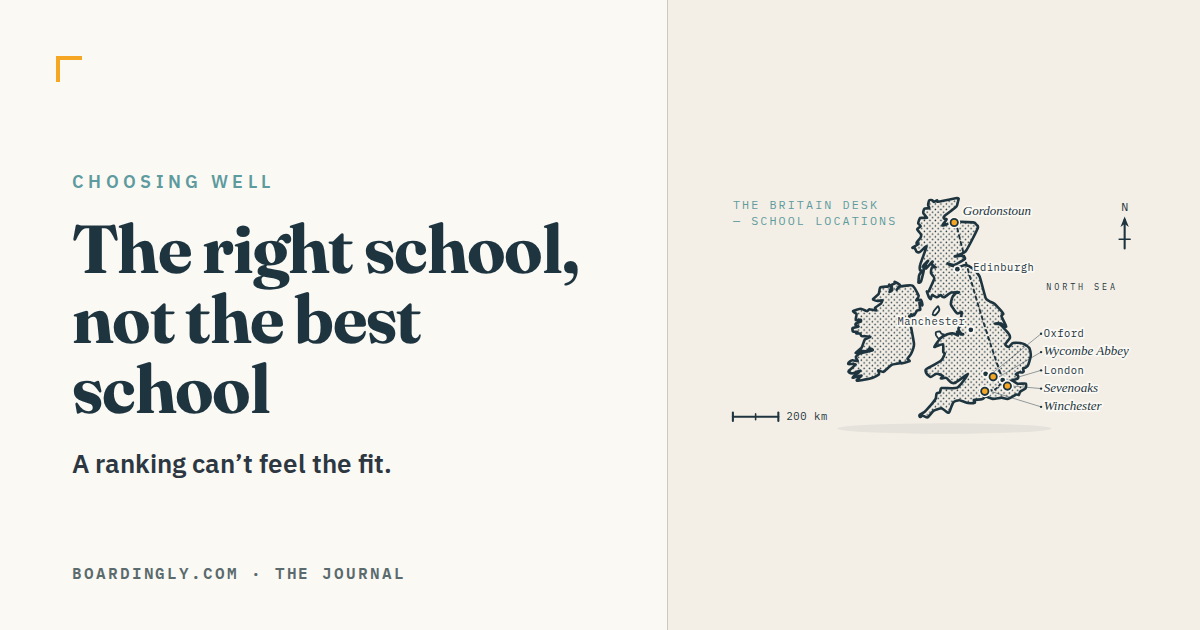
    In short. The UK boarding search is not short of information. League tables, ISI reports and the Good Schools Guide already exist. What families lack is interpretation: will this school suit my child? Most tools describe the school. Almost none model fit. Six dimensions decide whether a child thrives, and reputation is only one weak signal among them.
    It is close to midnight and there are nineteen tabs open. Each school website says roughly the same thing. Happy children on a lawn. A chapel. A line about character and academic ambition. A head’s welcome that could be swapped between any two of them and no one would notice. A mother in Singapore reads the same three paragraphs for the ninth time and still cannot answer the only question she came with: would my son be happy here, and would he do well?
    She is not short of information. She is drowning in it. What she needs is someone to read it for her child, and no website will do that.

    Why more information does not help

    The instinct, faced with a decision this large, is to gather more. More tables. More reports. More open-day dates in the calendar. The assumption is that somewhere in the pile sits the answer, and enough reading will surface it.
    It will not, because the pile is not built for the question. A league table ranks schools by exam results. An ISI report inspects a school against a national standard. The Good Schools Guide writes an honest paragraph about the place. All three are useful. All three describe the school. None of them knows your child: how she learns, how she recovers from a setback, whether she needs to be seen on a Tuesday afternoon when nothing is going wrong.
    That gap has a name. It is an interpretation problem, not an information problem. The facts are public. The reading of them, against one specific child, is the work almost nobody does.

    The six dimensions of fit

    Fit is not a feeling. It breaks down into parts you can actually examine. We use six. A school can score well on one and badly on another, and the pattern matters more than any single line.

    Fit dimension The question it answers What a poor fit looks like
    **Academic pace** Will the child keep up, recover, grow, or be stretched at this school’s speed? A steady learner placed where the middle of the class is moving faster than she can hold. Confidence goes first, then results.
    **Pastoral depth** Will the school actually know this child and act when something is wrong? Care that exists on paper. A tutor with too many names to hold, so quiet struggles go unseen for a term.
    **Boarding ethos** Is boarding real and active here, and does it suit a child who cannot fly home at half term? A house that empties on Friday. Full boarders left in a near-deserted building while day pupils go home.
    **Culture and values** Will the child, and the family, feel socially at ease here? A child who never finds their people because the social centre of the school sits somewhere they cannot reach.
    **SEN / learning support** Can it genuinely support dyslexia, ADHD, ASD, EAL, or a knock to confidence? A learning-support office that assesses well but hands the child back to classrooms that do not change.
    **Admissions probability** Given timing and selectivity, is this a realistic application at all? A family spends a year, and real hope, on a school that was never going to offer at that entry point.

    Read down that table for a real child and the famous names start to sort themselves. A school can be excellent and still wrong. The boarding-ethos line alone rules out schools that many overseas families would otherwise pay for, because a house that empties at weekends is no home for a child eight time zones from their own.
    None of these dimensions is visible on a website. Each is knowable. It takes reading the inspection reports properly, asking houseparents the questions that expose a weekend-empty house, and knowing which schools quietly move learning support from the brochure into the classroom and which do not.

    The label parents actually need

    Fit deserves an honest label, not a star rating, and it is a structured read rather than a score the data can prove to the decimal. A number out of five flattens the very thing that matters. What helps a family is a plain label that says what the pattern means for their child:
    Strong fit across the dimensions that matter most to this family.
    Fit with a watch-point. Good overall, but one dimension needs a direct question before you apply.
    Stretch. Reachable, but the child would be working near the top of their capacity from day one.
    Poor fit despite reputation. A well-known, well-regarded school that is, for this child, the wrong place.
    That last label is the one nobody else will give you. Every other source has a reason to keep a famous school on the list. The school wants the application. The rankings reward the name. The received wisdom of the expat WhatsApp group treats certain schools as prizes to be won.
    A family needs the opposite. Permission to cross a celebrated school off the list and feel relief rather than loss. “Poor fit despite reputation” is not a criticism of the school. It is a statement about a child, and it is often the most freeing sentence in the whole search.

    The opinion: league-table rank is the last filter, not the first

    Here is the line we will defend. Most families open the search with the league table. They should close with it.
    A school’s exam ranking measures its intake at least as much as its teaching. Take the most academically selective schools in the country and they will sit high in any table almost regardless of what happens in the classrooms, because they admitted children who were going to score highly anyway. The table rewards selection. It is close to silent on the thing a parent actually wants to know, which is what a school does with a child once it has them. Does it lift the steady learner? Does it hold the anxious one? Does it stretch the able one without breaking them?
    Rank cannot answer that. Fit can. None of this means rank does not matter. Prestige, a strong peer group and a name that travels are real goods, and plenty of families want them for real reasons. The argument is only about sequence: rank is the last filter, not no filter. It earns its place at the end of the process, as a tie-breaker between two schools that already suit the child, and not at the beginning, where it quietly deletes good options and waves through wrong ones.
    Start with the child. Work through the six dimensions. Build a shortlist of schools that fit. Then, and only then, let the ranking sort the ones that are left.

    Where this leaves the midnight tabs

    The mother in Singapore does not need a nineteenth reading of the same three paragraphs. She needs the paragraphs read against her son: his pace, the support he needs, whether the house he would live in is full on a Saturday, whether the offer is even realistic for his entry year.
    Do that work and the tabs close themselves. Three or four schools remain, each of them a genuine fit, each for reasons she can name. The league table becomes what it should always have been: the last filter, not the first.
    We can read the reports so a family does not have to, and we can model fit across all six dimensions. We can tell you where a famous name is the wrong home for your particular child. What we will not do is make the choice. The data guides. The decision, as it should, belongs to the family.

  • The World-Ready Scorecard: judging a school by the life it prepares a child for

    The World-Ready Scorecard: judging a school by the life it prepares a child for

    In short. A league-table rank measures a school’s exam results and, quietly, the intake that produced them. It does not measure whether a child leaves ready for a global life and a career that may not exist yet. The World-Ready Scorecard is our attempt to measure that instead: six things a boarding school can actually build in a child, read from verified data rather than reputation.

    The most useful sentence a head ever said to me was an admission. We were standing in a school workshop, and I asked him what his best leavers had in common. He thought about it and said: “Not their grades. I can tell you their grades. I cannot tell you which of them will be any good at thirty.” He ran one of the strongest academic schools in the country, and he was telling me that the number everyone ranks him by is the number he trusts least.

    That gap is the whole problem. A parent choosing a boarding school from Lagos or Singapore is handed one instrument: the league table. It is precise, it is public, and it answers a question most parents are not really asking. They are not buying a percentage of A grades. They are buying the twenty years that come after school, for a child who will work in cities and industries that appear on no prospectus. The table cannot see that far. Nothing in the category can, so we are trying to build the thing that does.

    Call it the World-Ready Scorecard. It is early, and I would rather say so than dress it up. It is not a ranking, it is not for sale, and no school can pay to move on it. It is a way of reading a school against a different question. Not “how selective is it”, but “what does it leave a child able to do”. Six dimensions, each drawn from data we can verify rather than adjectives a school writes about itself.

    Global outlook

    Not the raw percentage of overseas pupils, which can describe a school that segregates as easily as one that mixes. The real signal is whether a child leaves genuinely at home in the world: languages taught to fluency, exchanges that actually happen, a pupil body that integrates, a place where being from Lagos or Hong Kong is ordinary rather than remarkable.

    Independence

    This is boarding’s real dividend, and the one thing a day school struggles to match. A child who has run their own week since thirteen, managed their own time, and lived alongside people they did not choose arrives at university already able to do the thing most first-years are learning from scratch. It shows in how much a school hands over, and when.

    Applied and digital capability

    The child who can make something, not only pass an exam about it. Engineering, computing, design, enterprise: workshops that get used, code that ships, a Formula 1 in Schools team that competes. The Builder needs this most, but so does everyone, because “able to build” has quietly become a general skill rather than a specialist one.

    Character under load

    The CCF, a Duke of Edinburgh gold, an expedition, a service programme, a season of getting up at six to train. These are not decoration on a university form. They are the closest a school comes to rehearsing what a career actually tests: doing hard things when no one is watching and you would rather not.

    Communication and judgement

    Can the child think in public, and hold an argument that is not their own? Debate, an EPQ, real writing, a culture where being interesting counts for more than being right. This is the quality employers name most often and schools measure least.

    Destinations that fit the child

    Not the count of offers from two famous universities, which is usually a story about who a school admits rather than what it does for them. The honest signal is a pattern across three years of leavers going to the right places for who they are: the artist to a studio, the engineer to a workshop, the historian to a seminar. A school that sends everyone to the same five destinations is telling you it has one mould.

    Why this beats the table for most families

    Here is the opinion I will defend. A school that scores high on the World-Ready dimensions and middling on the league table is, for most international families, the better buy. The table rewards a school for its intake and for teaching to an exam. The scorecard looks instead at what a school demonstrably offers a child across those six dimensions. I will not pretend we can prove causation, that this school added a given outcome. Nobody honestly can, and any scorecard that claims to is overreaching. What we can do is read verified provision against your child, which is a better question than rank, while being honest that it is a reading, not a verdict. Only one of these is still paying out when your child is thirty and the exam is a memory.

    I want to be honest about the limits. Some of these are harder to measure than a fee or a pass rate, and we will get individual reads wrong before we get them right. Character does not sit in a spreadsheet as cleanly as a grade. But hard to measure is not the same as not worth measuring, and the alternative is what the category already does: rank schools by the number that is easy to count, and call it guidance. We would rather build the harder instrument slowly than sell the easy one confidently.

    None of this replaces fit. A school can be strong on every World-Ready dimension and still be wrong for your particular child, which is why the scorecard sits beside the fit model, not on top of it. One tells you what a school builds. The other tells you whether it will build it in this child. A family needs both, in that order, and neither of them is a league table.

    Ask a school the World-Ready questions on your next tour. Watch which ones reach for evidence, and which ones reach for the brochure.

  • How the Boardingly Worldly Ranking works

    How the Boardingly Worldly Ranking works

    Every league table answers the same question: who did this school let in? Sort by exam results and you have mostly sorted by admissions policy. The most selective schools take the strongest pupils and, unsurprisingly, post the strongest grades. The table calls that quality. We call it circular.

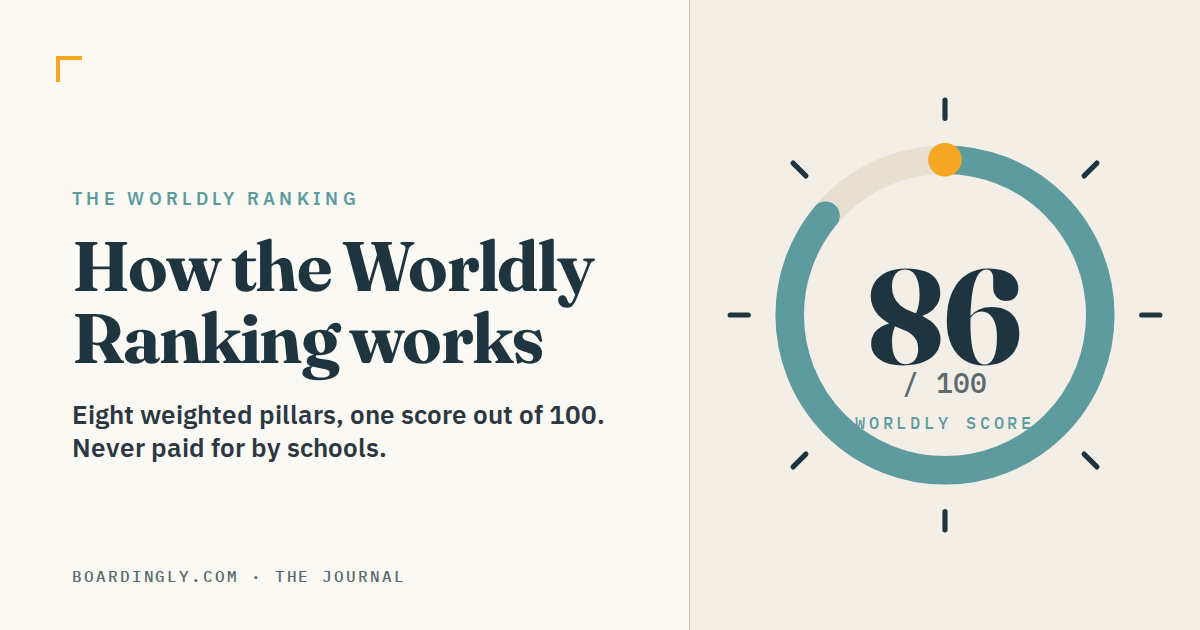
    The Boardingly Worldly Ranking asks a different question. Not who a school admits, but what it does with them. It is a single score out of 100, built from eight weighted pillars, and no school can pay to move it.

    What is the Boardingly Worldly Ranking?

    It is an evidence-based score, from 0 to 100, of how well a school develops a worldly child: one ready to go into the world happy, creative, financially literate, cross-culturally aware, high in empathy and socially minded. Each of eight pillars scores out of 100 from publicly sourced data, then rolls up by fixed weights into one composite number.

    The score is the same for every family. It measures the school, not your child. Matching your child comes after, once you have added their type to their profile.

    The eight pillars, and what each weighs

    The weights are fixed. They are the same for every school and every reader. A stronger academic record counts for more than a stronger staffroom sentiment, and the table says so plainly.

    Pillar What it measures Weight
    Brains Trust Academic results, subject breadth, exam outcomes 25%
    Forward Thinking Innovation in curriculum, technology, teaching 15%
    Alumni Power The reach of who the school actually produces 15%
    Bragging Rights Standing and regard among peers and the sector 10%
    Trophy Cabinet Awards and competitive wins, in and out of the classroom 10%
    In the Public Eye Press coverage: how often, and how well 10%
    Parent Views What current and former parents actually say 10%
    Staffroom View The view from inside, not the boardroom 5%

    Academic strength carries the most weight, at a quarter of the score. But it is a quarter, not the whole. A school can post brilliant results and still score modestly if it does little for a child beyond the exam hall. That is the point.

    Why it isn’t another league table

    A league table measures the intake. The Worldly Ranking tries to measure the formation. Those are different things, and confusing them is how families end up at a celebrated school that does not fit their child.

    Take two schools with identical A-level results. One runs genuine research partnerships with a university and sends pupils to national competitions. The other coaches hard to the exam and little beyond it. The league table cannot tell them apart. The Worldly Ranking can, because Forward Thinking, Trophy Cabinet and the rest carry weight the table ignores.

    That is the defended position here. Results tell you who a school admitted. They tell you very little about what the school will do with your particular child over five years.

    Why schools never pay

    We take no money from schools, ever, in exchange for their score or their place in it. This is not a courtesy. It is the whole product.

    The moment a school could buy a better number, the number would be worth nothing, and every family would be right to ignore it. We represent the family, not the school. The ranking earns its keep only by being honest, so it stays free of the people it judges.

    What happens when the data is thin

    Missing evidence is not a free pass. If a pillar has no reliable public signal, it scores zero and still counts at full weight. Sparse data pulls a score down rather than being quietly excused. Each school also carries a coverage figure, so you can see how much of the picture is built on real signals rather than gaps.

    This keeps the score honest in the other direction too. A school cannot look strong simply because we know little about it.

    How to use the score

    Use it early, to build a list, not late, to settle an argument. A high Worldly Ranking earns a school a place on your shortlist. It does not end the decision. The decision belongs to you, once you have weighed the score against your child’s type, the fees, the location and the visit.

    Add your child’s type to their profile and the ranking gains a second layer: the schools that suit your child rise to the top, not just the schools that score well in the abstract.

    See how your child’s type sharpens the ranking →

    The full method, pillar by pillar, sits on the Boardingly Worldly Approach page.

    Frequently asked questions

    Is the Worldly Ranking the same as a school’s exam results?
    No. Academic results are one pillar, Brains Trust, worth 25%. The other 75% covers innovation, alumni, standing, awards, press, parent views and the staffroom.

    Do schools pay to appear or to rank higher?
    Never. No school pays for its score or placement. If that ever changed, the ranking would be worthless, so it won’t.

    Why is one school’s score lower despite good results?
    Because results are a quarter of the score. A school strong on exams but thin on the other seven pillars will score lower than one that is strong across the board.

    Does the ranking tell me which school is right for my child?
    Not on its own. The score measures the school. Add your child’s type to their profile and Boardingly layers fit on top, so you see the schools that suit your child, not just the highest scorers.

    The number is a starting question

    A ranking is only ever a good first question, never the last word. The Worldly Ranking is built to get you to a better shortlist faster, and to be honest about how it got there. What it will not do is make the decision for you. That still belongs to the people who know the child.