You can usually tell before the tour ends. One child makes straight for the boathouse and barely looks at the science block. Another asks the head three questions about the debating society and none about the food. The prospectus you came to read is already beside the point. Children show you who they are.
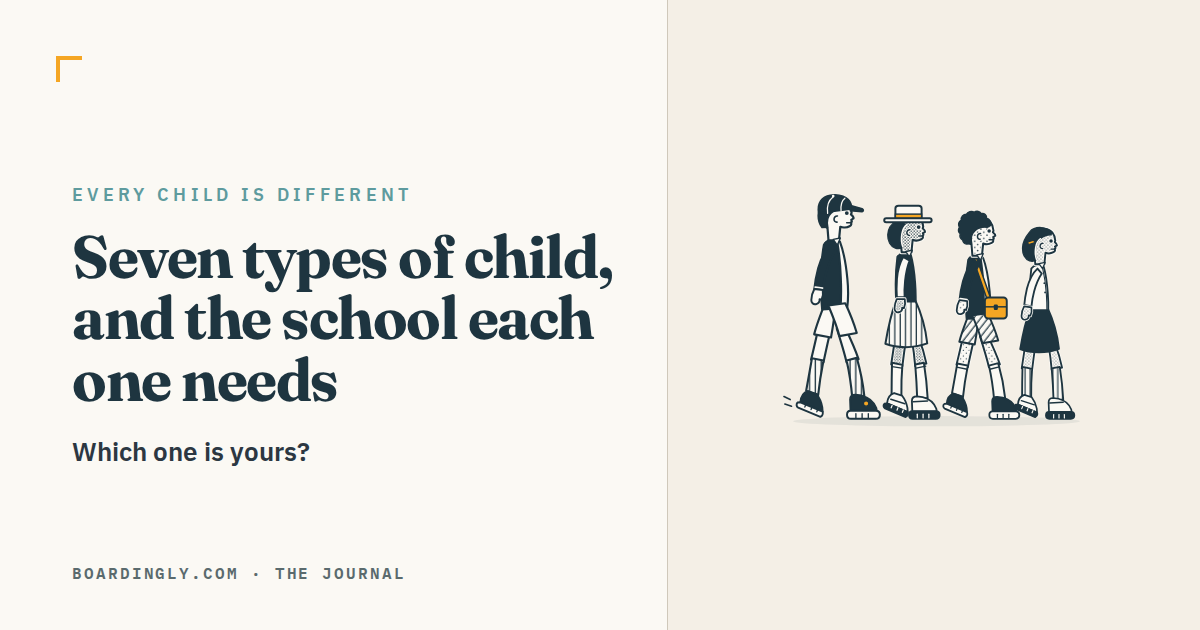
We keep meeting the same seven types. Naming the one or two that fit your child is the quickest way to see which schools belong on your list, and which ones never did. Here they are, how to spot each, and what the right school looks like once you have.
What are the seven types of child?
They are patterns, not labels. Most children are a blend of two, and the blend is the useful part. A child who is both a Thinker and an Explorer wants a different school from one who is a Thinker and a Quiet Observer, even though both love ideas.
| Type | You’ll recognise them by | What the right school has | Read more |
|---|---|---|---|
| The Builder | Takes things apart, codes for fun, wants to know how it works | Real labs, design and engineering, a route to a startup or a research group | The Builder |
| The Artist | Lives for the studio, the stage, the instrument | Serious conservatoire and portfolio pathways, not art as a reward for finishing the real work | The Artist |
| The Thinker | Reads the next chapter unasked, argues because they’ve thought about it | Breadth, debate, teachers who feed a mind that is already ahead | The Thinker |
| The Athlete | Happiest on the pitch, the water, the track | Sport as a development pathway with real coaching, not a Wednesday afternoon | The Athlete |
| The Explorer | Curious past the border, wants the language and the exchange | Genuine international programmes, the IB, exchanges that actually travel | The Explorer |
| The Quiet Observer | Reflective, deep focus, needs room to think | Small classes, careful pastoral care, a place that notices the quiet ones | The Quiet Observer |
| The Networker | Warm, makes friends everywhere, thrives on belonging | A small, close-knit school where everyone is known by name | The Networker |
How do you tell which type your child is?
Watch what they do when no one is setting the task. The type shows up in the unstructured hour, not the timetabled one. The child who fills a free afternoon with a half-built machine is telling you something the exam results won’t.
Listen to what they complain about, too. A Thinker complains of boredom when the work is easy, not when it’s hard. An Athlete goes flat without a season to train for. A Quiet Observer comes home drained by a school that never stops. The frustration points at the type as clearly as the enthusiasm does.
And ask them. Older children often know exactly which two of the seven they are, once you show them the list. Younger ones need you to read it for them, from the evidence of an ordinary week.
Most children are two types, not one
Here is the mistake worth avoiding: forcing a child into a single box. Real children are combinations. A Builder who is also a Networker will wilt in a brilliant, cold, individualist school and come alive in a warm one with a good workshop. The second type is often the one that decides fit, because it tells you about the environment rather than the subject.
So pick two. The pair describes your child more honestly than either alone, and it does more work when you start comparing schools.
Why does the type change the school?
Because the same school is a gift to one child and a slow disappointment to another, and the league table cannot tell you which. Rankings reward selectivity and exam output. They are silent on whether a talented Artist will be taken as seriously as they take themselves, or whether a Quiet Observer will be seen at all in a big, loud, high-achieving house.
The biggest mistake we see international families make is choosing the school before they have understood the child. Prestige is the wrong first question. The right first question is who your child is, because that is the thing the prospectus can’t answer and the thing that decides whether five years abroad build them or bruise them.
Read the child, then read the school. In that order the shortlist gets shorter and better on the same afternoon.
How to use your child’s type on Boardingly
Every school on Boardingly carries a Worldly Ranking, our view of how well a school develops a child ready for the world. When you add your child’s type to their profile, the recommendations stop being generic and start being theirs. An Athlete sees the schools where sport is a real pathway. An Explorer sees the ones with genuine international depth.
Add up to two types to your child’s profile and the matching sharpens straight away. It takes a minute, and it changes what you see first.
Add your child’s type to their profile →
Not sure where to start? The Boardingly Worldly Approach explains the seven types and the eight things we measure in every school.
Frequently asked questions
Can a child be more than two types?
They can lean toward several, but two is the useful limit. Picking your child’s strongest two keeps the recommendations sharp. A longer list waters them down.
My child seems to have changed. Should I update the type?
Yes. Children grow into and out of types, especially between 11 and 16. Revisit the profile when the evidence of an ordinary week changes.
Does the type override the academic side?
No. Academic strength is built into every school’s Worldly Ranking already. The type sits on top, to match your child to the environment, the pathway and the pastoral fit that the ranking alone won’t capture.
We’re applying from overseas. Does the type still help?
It helps more. When you can’t visit six schools in a term, a sharper shortlist saves the trips that matter for the ones worth taking.
Start with the child
A school is not good or bad in the abstract. It is good or bad for a particular child, in a particular pair of types, at a particular age. Start there. The right school is the one that fits the child you have, not the one the league table happens to admire.
Read the child first. The list gets shorter, and the decision gets easier.