Blog

  • What Boarding Is Really Like at 13

    What Boarding Is Really Like at 13

    In short. Most days run to a shape: lessons in the morning, sport or clubs every afternoon, an hour or two of prep, then house time before bed. You’ll probably share a room at first. The food is fine, sometimes great. Homesickness is normal early on and it passes.
    You’re on the wing, boots on, and someone from your house shouts your name because a defender’s gone down and they’re a man short. You’ve been at the school four days. You don’t know half these lads. You go on anyway. Twenty minutes later you’ve made a tackle, someone’s clapped you on the back, and you realise you haven’t thought about home once. That’s the bit no brochure tells you. Boarding is mostly stuff to do, with people, all the time.
    Here’s what actually fills the day.

    What do you even do all afternoon?

    Sport and clubs. Nearly every day. Most boarding schools build the afternoon around activity, not lessons. So after morning classes you’ll be out for rugby, football, hockey, cricket in summer, or swimming, running, rowing, whatever the school’s set up for. If team sport isn’t your thing, there’s usually loads else: climbing, music, drama, art, coding, chess, debating, CCF (a bit like a taster of military training, fully optional), and Duke of Edinburgh with outdoor pursuits and expeditions at weekends.
    The honest version: some afternoons you’ll love, some you’ll drag yourself through. You don’t have to be good at sport. You have to turn up and have a go. That’s genuinely most of it. Turn up, have a go, and within a few weeks you’ll have found the two or three things you actually like.

    What about free time, gaming and my phone?

    You do get free time. Not loads on a weekday, but real gaps: before breakfast, between the end of prep and bed, more at weekends.
    Now the honest part, because this is the question every boy actually wants answered. Screen rules vary a lot by school, and you need to check the specific one you’re looking at. Some hand phones back at set times each day. Some collect them at night, especially for younger years, so they’re not in the dorm at 1am. Gaming consoles are often allowed in common rooms or house social time but not on school nights, or only at weekends. A few schools are stricter than that. A few are more relaxed.
    Nobody’s pretending 13-year-olds don’t want their phones. The rules exist so the place doesn’t turn into everyone sitting alone on a screen. Ask the exact policy before you go. If a school won’t tell you straight, that tells you something too.

    Do I have to share a room?

    At 13, usually yes, at least to start. Many schools put new younger boys in a shared room or a small dorm of three or four. As you go up the school you tend to get more privacy, and by the sixth form lots of boys have their own study bedroom.
    Sharing sounds worse than it is. You get a bed, a desk, somewhere for your stuff, and a roommate who’s as nervous as you on night one. Most boys say the shared start is where they made their first proper mates. You learn to live alongside someone, sort out whose turn it is to be quiet, and get on with it. It’s a decent skill to have.

    What’s the house actually like?

    Your house is your base. It’s the building you sleep in, eat some meals in, and hang around in. It’s run by a houseparent (sometimes called a housemaster) who lives there, plus other staff and often a matron who sorts out anything from a lost sock to feeling rotten.
    Here’s the thing that surprises people: houses mix year groups on purpose. You won’t just be with other 13-year-olds. There’ll be older boys around too, and that’s by design. The house becomes a bit like a big, slightly chaotic family. You get common rooms, table tennis or a pool table, a kitchen for toast at odd hours, and people to talk to.

    What are the older boys actually like?

    This is the worry a lot of 13-year-olds carry in silently, so let’s be straight. Mostly, they’re fine. Genuinely. The older ones have been the new boy themselves, they remember it, and most of them are decent to the younger years. Some become the ones who show you the ropes.
    Schools take this seriously. There are prefects, house staff living in, and clear rules, because mixing the years only works if the younger boys are looked after. If something’s off, if anyone’s unkind or worse, you tell a houseparent or matron and it gets dealt with. That’s what they’re there for. Don’t sit on it. But go in expecting the older boys to be alright, because usually they are. And the mixing only works because staff supervise it. It is not just rules on a wall: there are adults living in, and prefects whose job is to keep the younger ones safe. If anything crosses a line, you tell someone and it gets dealt with.

    If something feels wrong, not just homesick

    Missing home is normal and it passes. But if it doesn’t get better, or something feels wrong — someone is unkind or unsafe, you can’t sleep or eat, or you just can’t cope — tell your houseparent, matron, or your parents straight away. That is the strong thing to do. Some things are more than homesickness, and the adults are there for exactly this.

    What’s the food like?

    Better than you’re expecting, honestly. Most boarding schools have a big dining hall, hot meals three times a day, and a proper choice, including a vegetarian option and usually a salad bar you’ll ignore until about age 16. There’ll be days the food is brilliant and days it’s just fuel. Roast on a Sunday tends to be a highlight. And your house kitchen means toast, cereal or a snack when you’re hungry between meals, which at 13 is roughly always.

    A weekday at 13, hour by hour

    Every school’s timetable is different, but a typical weekday looks something like this:

    Time What’s happening
    7:15 Wake up, shower, get into uniform
    7:45 Breakfast in the dining hall
    8:30 Registration in your house, notices for the day
    9:00 Morning lessons (a few periods, short break in between)
    1:00 Lunch
    2:00 Afternoon lessons or straight into sport
    3:45 Sport, clubs or activities
    5:30 Back to the house, shower, downtime
    6:00 Prep (homework, quiet, supervised)
    7:15 Supper
    8:00 House time, common room, free time, screens if allowed
    9:30 Younger years head to bed (older years later)

    Weekends are looser: matches, trips, more free time, a lie-in.

    What if I feel homesick?

    You probably will, a bit, in the first week or two. Missing home doesn’t mean you’ve made a mistake or that you’re soft. It means you’ve got a home worth missing. Nearly every boarder feels it early. Nearly every one of them stops feeling it once the days fill up and the mates arrive.
    Tell someone if it’s heavy. Your houseparent and matron have seen it a hundred times and know exactly what helps. Ring home when you’re allowed. Then go and find the football, or the club, or the lad down the corridor who looks as lost as you feel.
    That’s the whole trick, really. The homesickness fades because you get busy, and you get busy because there’s genuinely something on every single afternoon. Give it a fortnight. Then check how you feel.
  • Starting Boarding at 13: An Honest Guide for You

    Starting Boarding at 13: An Honest Guide for You

    In short. Starting boarding at 13 is a big change, and feeling nervous is completely normal. Most people wobble a bit in the first fortnight, then settle. This guide answers the real questions: making friends, the food, phones, homesickness, weekends, and what that first week actually feels like.
    It’s the moment your family’s car pulls away. You’ve unpacked half a bag, your room smells like someone else’s washing powder, and a girl you’ve never met is standing in the doorway asking if you want to come down for tea. Your stomach does something odd. Part of you wants to go. Part of you wants to cry. Both of those are fine. Honestly, both at once is the most normal thing in the world on day one.
    So here are straight answers to the things you’re probably actually wondering, from someone who remembers what that first night felt like.

    Will I make friends?

    Yes. And sooner than you think, because everyone else is in exactly the same boat.
    Here’s the thing nobody says out loud: the other new girls are just as nervous as you. The confident-looking one who seems to know everyone? She’s faking it a bit too. When you all start together, there’s no established group you have to break into. You’re building it together from scratch.
    Friendships at boarding school form fast because you’re around each other all the time. You eat together, do prep together, watch films in the common room, moan about the early mornings. That much shared time does something. By half term you’ll have people who feel like family.
    You don’t have to be best friends with everyone. You just need one or two people you click with. Say yes to things in the first couple of weeks even when you don’t feel like it. That’s where the friends are.

    What is the food really like?

    Better than you’re expecting, and worse than your mum’s. Both true.
    Most schools do a canteen or dining hall with a few choices at each meal. There’s usually a hot option, a veggie option, a salad bar, and something with chips more often than your parents would like. Some days it’s genuinely good. Some days you’ll text home a photo captioned “help”. That’s boarding food. Everyone complains about it and everyone eats it.
    If you’re vegetarian, coeliac, or have allergies, the school will cater for you, but tell them clearly and early. Ask your parents to put it in writing before you arrive. The kitchen staff are usually lovely once they know you by name.

    Can I keep my phone?

    This one really depends on your school, so check your school’s exact rules before you pack.
    Some schools let you keep your phone and just have “off” times, like after lights out. Others collect phones overnight and give them back in the morning. A few have tighter rules for younger years and loosen them as you go up the school. There’s no single answer, which is why you need to look at your specific school’s policy or ask your houseparent directly.
    What’s true almost everywhere: you’ll be able to contact home. Calls, messages, sometimes a house phone. You will not be cut off from your family. If the phone rules worry you, that’s a completely fair question to ask on your first day. Nobody will think it’s silly.

    Will I be homesick? Is that normal?

    Yes, probably. And yes, completely normal.
    Homesickness isn’t a sign you’ve made a mistake or that you’re not cut out for this. It’s just what happens when you love your home and you’re not in it. Even girls who end up adoring boarding get homesick at the start. It often hits hardest at night, or on a Sunday, or right after a lovely phone call with your mum.
    Here’s the honest bit: the first two weeks can wobble. You might feel great in the morning and wretched by bedtime. Then, usually, it lifts. Not because someone fixed it, but because the place slowly starts to feel like yours. The corridors stop being strange. You have a seat you always sit in. It creeps up on you.
    If it doesn’t lift, or it feels too heavy to carry, tell someone. That’s not weakness. That’s the smart thing to do.

    If something feels wrong, not just homesick

    Missing home is normal and it passes. But some things are more than homesickness. If it doesn’t get better, or something feels wrong — someone is unkind or unsafe, you can’t sleep or eat, or you just can’t cope — tell your houseparent, matron, or your parents straight away. That is the strong thing to do, not the weak one. The adults are there for exactly this, and you will be taken seriously.

    Who actually looks after me?

    Your house. Boarding schools are split into houses, which is basically a big home with a group of pupils and the adults who look after them.
    The main grown-up is your houseparent (sometimes called a housemistress). They run the house, they know every girl in it, and a lot of their job is noticing when someone’s having a rough time. There are usually other staff too: a matron who sorts out plasters, laundry and homesick evenings, and older pupils called prefects or seniors who help the new ones settle.
    You are not meant to cope alone. If you can’t sleep, if you’ve fallen out with someone, if you just want to talk, that’s exactly what these people are there for. Knocking on the houseparent’s door is normal. Everyone does it.

    What do you even do at weekends?

    More than you’d think, and some blissful nothing too.
    Weekends are a mix. There’s usually sport on Saturdays, matches or training. Then clubs, trips into town, film nights, baking, art, music, sometimes a coach trip somewhere. Sundays are often slower: a lie-in, prep, calling home, hanging around the common room in pyjamas.
    You won’t be entertained every second, and that’s a good thing. Some of the best boarding memories are the unplanned ones. Sitting on someone’s floor at 9pm eating snacks from the tuck shop and laughing about nothing.

    What is the first week actually like?

    A blur. A good blur, mostly, with a couple of hard evenings threaded through.
    You’ll be handed a timetable and a map and you’ll get lost anyway. You’ll forget names and have to ask twice. You’ll be tired in a way you’re not used to, because your brain is working overtime just learning where everything is. And somewhere in that week, usually when you’re not looking for it, you’ll have a proper laugh with someone and realise you’re okay. Here’s a rough guide to what actually helps.

    What to pack that actually helps

    • A photo or two from home. Not your whole family album. One or two, by your bed.
    • Something that smells like home. A jumper, a pillowcase, a specific shampoo. Smell is weirdly powerful for homesickness.
    • A cosy blanket or throw. Makes a strange bed feel like yours in about ten seconds.
    • A door snack stash. Biscuits or sweets to share. Sharing food makes friends fast.
    • A refillable water bottle and a small torch. Dull, but you’ll use both constantly.
    • Stamps, an envelope, and your family’s address written down. A real letter home lands differently than a text.
    • A list of who to call and when. Your parents’ numbers, and your houseparent’s name, written somewhere you can find it at 10pm.
    • Comfy clothes for the common room. You live in these more than your uniform.
      Pack the practical stuff, yes. But the things that help most are the small ones that make a new room feel like it’s yours.
      One last thing, and I mean it. The girl standing in your doorway on day one, asking if you’re coming down for tea? A few weeks from now, that might be you, knocking on a new girl’s door. You’ll remember exactly how the first night felt, and you’ll be the reason hers is a little easier. That’s how this works. You’ll be fine. Better than fine, probably. Go down for the tea.
  • Choosing a School for a Child Still Exploring

    Choosing a School for a Child Still Exploring

    In short. Most children aged 11 to 14 have not found their thing yet, and that is normal, not a delay. The right school keeps options open: broad tasters, strong pastoral care, and a culture that lets a child change their mind. For an undecided child, breadth beats one famous specialism.
    Her daughter came home from an open day quiet in a way that worried her. On the train, the girl finally said it. “Everyone there already knew what they were. There was a boy who had been rowing since he was nine. A girl who plays cello in some orchestra. I just like a bit of everything. I do not have a thing.”
    She is twelve. She is good at most of what she tries and certain of none of it. She reads widely, swims decently, drew a comic over half term, gave up the comic, took up the guitar, keeps the guitar in its case more often than not. Her mother had started to wonder whether this counted as a problem. It does not. It is the most ordinary thing in the world.

    Why “not knowing yet” is the normal setting

    There is a quiet pressure in the boarding-school conversation to arrive already sorted. Brochures photograph the county-level fencer and the child who codes. Parents at the school gates trade specialisms like currency. Somewhere in all of it, the good all-rounder starts to feel like the one who missed the memo.
    They did not miss anything. A child of eleven or twelve is still gathering the raw material that a real leaning is eventually made from. Interests at this age are wide, shallow, and quick to change, and that width is the point. It is how a child works out what they actually care about rather than what they were pointed at first.
    We would call this child an Explorer, on one condition: it is a stage, not a label. No eleven-year-old is one fixed sort of person, and the schools that quietly sort children into types early tend to be the ones a curious child grows out of. The Explorer is simply a child still trying doors. Most of them are. One honest caveat: there is a difference between happily exploring and quietly avoiding. A child who tries nothing, drops everything the moment it gets hard, or has gone flat rather than curious is telling you something else, and that is worth a closer look rather than just a broad school.

    What a leaning actually looks like when it arrives

    When a real interest does surface, it rarely arrives as a single clean category. Children tend to hold two or three leanings at once, and the mix is the interesting part.
    Some drift toward making and figuring out how things work. Give them a design-and-technology workshop, a robotics club, a first line of code, and they light up. Call it a Builder streak. Others come alive outdoors and under a bit of pressure: team sport, the Combined Cadet Force, a Duke of Edinburgh expedition with a heavy pack and a wrong turning to recover from. That is an Athlete and outdoorsperson leaning, and it often sits happily beside the workshop one.
    Then there is the child who needs to make things that mean something, on a stage or a page or in a practice room. And the one who simply wants to argue an idea to its end, who reads past the set text and asks the awkward second question. An Artist thread. A Thinker thread. Most Explorers carry a little of several. The girl on the train might turn out to be a Builder who acts, or a Thinker who climbs. You cannot know at twelve, and you are not meant to.
    The mistake is to buy the labels too early and shop for a school that matches one of them. You would be fitting a school to a child who does not exist yet.

    The one thing worth being firm about

    Here is the position, stated plainly. For a child who has not found their thing, breadth and pastoral depth usually beat a school built around one brilliant specialism. Not always. A specialist school with real beginner pathways and genuine range can suit an Explorer too, because the enemy is a narrow culture, not a specialism as such. But where breadth and a single famous strength genuinely trade off, breadth wins for the undecided child.
    A school famous for rowing, or maths, or music, is superb for the child who already knows they are a rower, a mathematician, a musician. For an Explorer, that same reputation is a narrowing force. The best coaching, the best kit, the strongest peer group all cluster around the one thing, and the culture gently makes the case that the one thing is what matters. A child still looking will either force a fit or feel like a spare part. Neither is what you are paying for.
    Breadth does the opposite. It lets a child try the CCF and hate it, take up double bass and mean it, discover in the DT workshop that they think with their hands. A wide taster base is not a lack of focus. It is how focus is found.

    What breadth looks like in practice

    Breadth is not the length of the activities list in the prospectus. Every school has a long list. What matters is whether a child can actually reach across it.
    Ask how easy it is to start something in the third week of term, not just in September. Ask whether a beginner can join the play, the boat, the band, or whether everything is streamed by ability from the start. Ask what happens when a child drops one thing and picks up another. At a school that suits an Explorer, that is a Tuesday. At a school that does not, it is a small failure that gets noticed.
    Look for real access to the full range: sport that is not only for the first team, music and drama open to the nervous beginner, a workshop and a coding club with the door genuinely open, outdoor pursuits and Duke of Edinburgh built into the calendar rather than bolted on. The test is whether an ordinary child, good at nothing in particular, gets a proper go at all of it.

    Why the house matters more than the trophy cabinet

    Breadth only works if someone is paying attention to the quiet child moving through it, and this is where boarding earns its keep or does not.
    A good boarding house notices. It sees the child who is doing fine on paper and slowly going flat underneath. It clocks the girl who has stopped signing up for things and asks why before it becomes a pattern. Strong pastoral care is the scaffolding that lets a child try and fail and try something else without any of it turning into a story about who they are.
    When you visit, watch the adults more than the buildings. Does the houseparent talk about children as people or as results? Can they describe a child who arrived unsure and found their feet, and can they tell you how? Ask directly how they spot a child who is quietly struggling, and whether they would tell you before you had to ask. A school that keeps the doors open long enough for a real leaning to appear is worth more to this child than any specialism.

    What an Explorer needs from a school

    A checklist to take to open days and hold the school against.
    A wide taster base with real access. Sport beyond the first team, music and drama open to beginners, a DT workshop and coding, plus outdoor pursuits and Duke of Edinburgh in the calendar, not on a poster.
    Low barriers to starting. A child can take up something new mid-year, as a beginner, without auditioning for the privilege.
    A culture that forgives changing your mind. Dropping one activity for another is routine, not a black mark.
    No early streaming into a single lane. The school does not decide who a child is at thirteen.
    A house that notices early. Pastoral staff who track the quiet child and reach out before you have to.
    People who talk about formation, not just results. Adults who can tell you how an unsure child found their feet here.
    Breadth valued over one famous specialism. The school is proud of range, not only of its trophy sport.
    The girl on the train does not need a school that will tell her what she is. She needs one that will wait with her while she finds out, and notice the day she does. That school is out there, and it is not the one with the loudest specialism. It is the one that keeps the doors open.

  • The Right School, Not the Best School

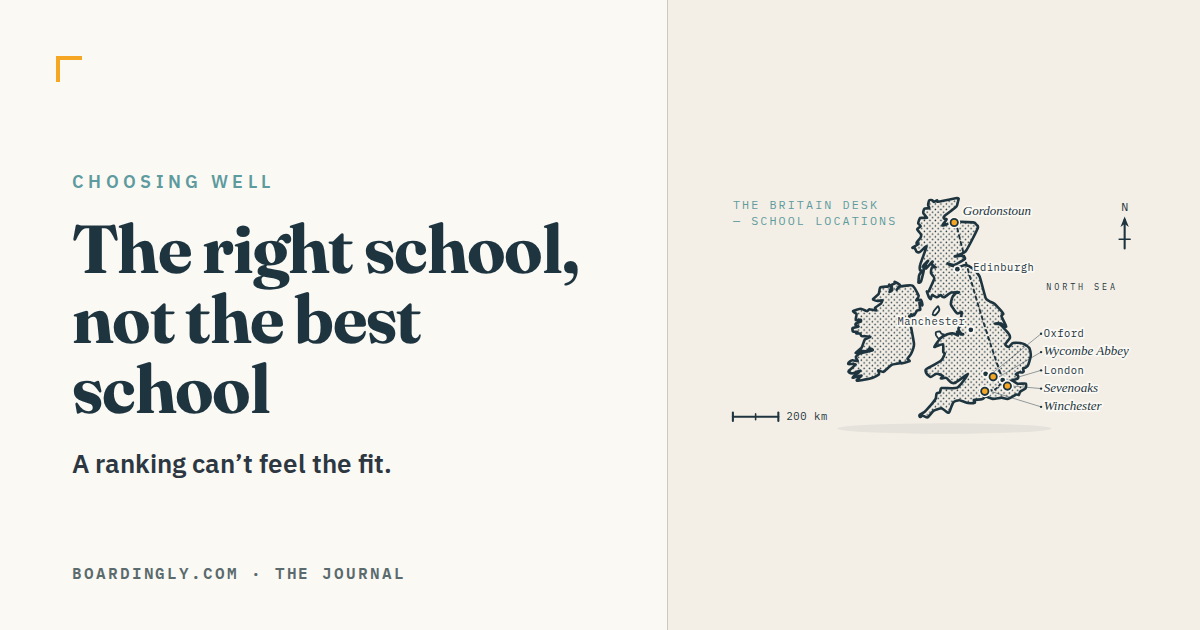
    The Right School, Not the Best School

    In short. The UK boarding search is not short of information. League tables, ISI reports and the Good Schools Guide already exist. What families lack is interpretation: will this school suit my child? Most tools describe the school. Almost none model fit. Six dimensions decide whether a child thrives, and reputation is only one weak signal among them.
    It is close to midnight and there are nineteen tabs open. Each school website says roughly the same thing. Happy children on a lawn. A chapel. A line about character and academic ambition. A head’s welcome that could be swapped between any two of them and no one would notice. A mother in Singapore reads the same three paragraphs for the ninth time and still cannot answer the only question she came with: would my son be happy here, and would he do well?
    She is not short of information. She is drowning in it. What she needs is someone to read it for her child, and no website will do that.

    Why more information does not help

    The instinct, faced with a decision this large, is to gather more. More tables. More reports. More open-day dates in the calendar. The assumption is that somewhere in the pile sits the answer, and enough reading will surface it.
    It will not, because the pile is not built for the question. A league table ranks schools by exam results. An ISI report inspects a school against a national standard. The Good Schools Guide writes an honest paragraph about the place. All three are useful. All three describe the school. None of them knows your child: how she learns, how she recovers from a setback, whether she needs to be seen on a Tuesday afternoon when nothing is going wrong.
    That gap has a name. It is an interpretation problem, not an information problem. The facts are public. The reading of them, against one specific child, is the work almost nobody does.

    The six dimensions of fit

    Fit is not a feeling. It breaks down into parts you can actually examine. We use six. A school can score well on one and badly on another, and the pattern matters more than any single line.

    Fit dimension The question it answers What a poor fit looks like
    **Academic pace** Will the child keep up, recover, grow, or be stretched at this school’s speed? A steady learner placed where the middle of the class is moving faster than she can hold. Confidence goes first, then results.
    **Pastoral depth** Will the school actually know this child and act when something is wrong? Care that exists on paper. A tutor with too many names to hold, so quiet struggles go unseen for a term.
    **Boarding ethos** Is boarding real and active here, and does it suit a child who cannot fly home at half term? A house that empties on Friday. Full boarders left in a near-deserted building while day pupils go home.
    **Culture and values** Will the child, and the family, feel socially at ease here? A child who never finds their people because the social centre of the school sits somewhere they cannot reach.
    **SEN / learning support** Can it genuinely support dyslexia, ADHD, ASD, EAL, or a knock to confidence? A learning-support office that assesses well but hands the child back to classrooms that do not change.
    **Admissions probability** Given timing and selectivity, is this a realistic application at all? A family spends a year, and real hope, on a school that was never going to offer at that entry point.

    Read down that table for a real child and the famous names start to sort themselves. A school can be excellent and still wrong. The boarding-ethos line alone rules out schools that many overseas families would otherwise pay for, because a house that empties at weekends is no home for a child eight time zones from their own.
    None of these dimensions is visible on a website. Each is knowable. It takes reading the inspection reports properly, asking houseparents the questions that expose a weekend-empty house, and knowing which schools quietly move learning support from the brochure into the classroom and which do not.

    The label parents actually need

    Fit deserves an honest label, not a star rating, and it is a structured read rather than a score the data can prove to the decimal. A number out of five flattens the very thing that matters. What helps a family is a plain label that says what the pattern means for their child:
    Strong fit across the dimensions that matter most to this family.
    Fit with a watch-point. Good overall, but one dimension needs a direct question before you apply.
    Stretch. Reachable, but the child would be working near the top of their capacity from day one.
    Poor fit despite reputation. A well-known, well-regarded school that is, for this child, the wrong place.
    That last label is the one nobody else will give you. Every other source has a reason to keep a famous school on the list. The school wants the application. The rankings reward the name. The received wisdom of the expat WhatsApp group treats certain schools as prizes to be won.
    A family needs the opposite. Permission to cross a celebrated school off the list and feel relief rather than loss. “Poor fit despite reputation” is not a criticism of the school. It is a statement about a child, and it is often the most freeing sentence in the whole search.

    The opinion: league-table rank is the last filter, not the first

    Here is the line we will defend. Most families open the search with the league table. They should close with it.
    A school’s exam ranking measures its intake at least as much as its teaching. Take the most academically selective schools in the country and they will sit high in any table almost regardless of what happens in the classrooms, because they admitted children who were going to score highly anyway. The table rewards selection. It is close to silent on the thing a parent actually wants to know, which is what a school does with a child once it has them. Does it lift the steady learner? Does it hold the anxious one? Does it stretch the able one without breaking them?
    Rank cannot answer that. Fit can. None of this means rank does not matter. Prestige, a strong peer group and a name that travels are real goods, and plenty of families want them for real reasons. The argument is only about sequence: rank is the last filter, not no filter. It earns its place at the end of the process, as a tie-breaker between two schools that already suit the child, and not at the beginning, where it quietly deletes good options and waves through wrong ones.
    Start with the child. Work through the six dimensions. Build a shortlist of schools that fit. Then, and only then, let the ranking sort the ones that are left.

    Where this leaves the midnight tabs

    The mother in Singapore does not need a nineteenth reading of the same three paragraphs. She needs the paragraphs read against her son: his pace, the support he needs, whether the house he would live in is full on a Saturday, whether the offer is even realistic for his entry year.
    Do that work and the tabs close themselves. Three or four schools remain, each of them a genuine fit, each for reasons she can name. The league table becomes what it should always have been: the last filter, not the first.
    We can read the reports so a family does not have to, and we can model fit across all six dimensions. We can tell you where a famous name is the wrong home for your particular child. What we will not do is make the choice. The data guides. The decision, as it should, belongs to the family.

  • UK Sixth Form at 16: Honest Pros and Cons

    UK Sixth Form at 16: Honest Pros and Cons

    In short. Joining a UK boarding sixth form at 16 gives an academically able child two years of serious study, real independence before university, and a fresh setting. The cost is time: only two years to belong, higher admissions risk late in the cycle, and a social step into a settled year group.
    A father in Singapore opens a school website at 11pm. His daughter is fifteen, doing well at a good international school, already talking about universities in Britain and the States. The brochure says the sixth form is the making of a young person. He believes about half of it. What he wants to know is the half nobody prints: what does it actually cost her to arrive at sixteen, two years before everyone else leaves?
    That is the real question behind 16+ entry. Not whether a UK boarding sixth form is good. Whether it is right for this child, at this moment, with this much runway left.

    What actually happens at 16+ entry

    In England, Year 12 is the first year of the sixth form. Pupils are sixteen turning seventeen. It is a natural entry point: children join from other schools, the year group reshuffles, and everyone picks a smaller set of subjects to study in depth. You choose a route here too. A-levels mean three, sometimes four, subjects studied deeply. The IB keeps six subjects plus an extended essay and theory of knowledge. Both are respected by universities. They ask different things of a child, and that choice matters more than most parents expect.
    So the move is real, but it is also short. Two academic years, then university applications land in the first term of the second one. The clock starts fast.

    The honest case for going

    For a child already strong at a good school, this is not a rescue. Nobody is being pulled out of a failing system. The move buys three things money and effort can actually deliver.
    The first is stretch. A strong sixth form sets a harder pace, marks with less mercy, and surrounds a bright child with others who find the work easy too. For a pupil who has been quietly top of the class for years, that is a gift. It is also a shock, and the shock is the point.
    The second is independence with a net. Boarding at sixteen means managing your own time, your own work, your own falling-out with a friend, all before the deep end of university. A child who learns to run their own week at seventeen arrives at eighteen already able to do it. That is a genuine advantage, and it is hard to buy any other way.
    The third is exposure. A boarding house pulls together children from twenty countries and makes them share a corridor. For a family that is already globally mobile, that widening of the world is often the real reason to go, more than any league table.

    The honest case against

    Now the other column, told straight.
    Two years is not long to belong. Friendships in a boarding house often formed at thirteen. A sixteen-year-old joins a group with its own history, its own jokes, its own settled shape. Most children find their footing by the end of the first term. Some take longer. A few never quite feel it was theirs. That is the honest range, and temperament decides where a given child lands.
    Then there is admissions risk, and it is the one families underrate. Good schools fill their 16+ places early, sometimes more than a year ahead. Apply late in the cycle and the strong, obvious choices may already be full, which quietly pushes a family toward whatever still has room. That is the wrong way round. The school should be chosen because it fits, not because it had a bed.
    There is also the exam switch. A child moving from one national system into A-levels or the IB is learning a new way of being examined at the same time as sitting the exams that decide university. Bright children manage it. It still costs energy in a year that has none to spare.
    There is a sharper version of this for US-bound families. American universities read four years of school, with teacher references and a transcript that assumes continuity. Moving at 16 can fracture exactly the record you are trying to strengthen: new teachers who have known your child for months, not years, and a broken through-line. For a child targeting the US, staying put can beat moving, and that calculation belongs in the decision before anything else.

    The honest ledger Weigh it against
    Serious academic stretch and a harder, faster pace A new exam system to learn late, in the year that counts
    Real independence before university, with staff nearby Only two years to bond in a year group formed at 13
    A fresh setting for a child ready to leave the local system Homesickness and a settled social scene to break into
    World exposure: a house of pupils from many countries Distance from home during a demanding stretch
    Choice of A-level depth or IB breadth Late applications: strong schools fill 16+ places early
    A springboard to UK and international universities Admissions probability shapes the shortlist, not just fit

    Read the table as one picture, not two lists. Every genuine gain on the left has a matching cost on the right. The decision is not whether the gains are real. They are. It is whether this child, with this much runway, can carry the costs and still come out ahead.

    Our position

    Here is where we will plant a flag. For an academically strong child already thriving at a good international school, going to a UK sixth form at 16 is worth it only when two things are true at once: the child is strong enough to win a place at a school that will genuinely stretch them, and that school is still the right fit late in the cycle. Chase one without the other and the move loses its point.
    If you apply late and aim only at fit, the best schools are full and you settle. If you apply late and aim only at what has space, you get a bed but not the stretch. The families who get this right hold both lines. They target schools where the child is a real contender and the school is right, and they move early enough that both are still on the table.
    That last part is the quiet lever. Admissions probability is not a detail to sort out after choosing. It shapes the shortlist from the first day. A place applied for eighteen months out is a different opportunity from the same place applied for in the spring before entry. Timing does not just affect whether you get in. It decides which schools you are honestly choosing between.

    So, go or stay?

    Stay if the current school still stretches your child and the only pull is a name on a gate. Two years is too short a run to trade a settled, working life for a marginal gain in prestige.
    Go if your child has outgrown the pace where they are, wants the independence, and can walk into a strange dining hall in September and make it theirs. Then the two years are not too short. They are exactly enough to arrive at university already having done the hard part.
    The father closing his laptop at midnight does not need the brochure’s half. He needs the other one, laid out plainly, so he can decide with his daughter rather than for her. That is the whole job. The data narrows the field. The choice stays in the family, where it belongs.

  • Is 13 too young to board? An honest answer for parents

    Is 13 too young to board? An honest answer for parents

    In short. Thirteen is not too young in itself. It is the standard UK boarding entry point, and thousands of settled, independent children thrive at it. The real question is not the age on the birth certificate. It is whether this particular child is ready, and whether the house will keep them known.
    You are in the car park at the end of an open day. Your daughter is thirteen. She liked the art rooms and the dog that belongs to the housemistress. You liked the housemistress. On the drive back, the question you actually flew in with is still sitting there. Is she too young for this?
    It is the right question. It is also, slightly, the wrong one.

    Why thirteen is the number in the first place

    Thirteen is not arbitrary. In the English system, Year 9 begins at thirteen, and 13+ has long been the main gateway into senior boarding schools. Common Entrance, the traditional exam at this stage, exists precisely because so many families move their children in at this point. The houses are built around it. The friendship groups form around it. A child arriving at thirteen is arriving with everyone else, not slipping into a group that set two years ago.
    That matters more than parents expect. Arriving on time is easier than arriving early or late. So the age itself is well chosen. The system was designed around it. Which is exactly why the age is not the thing to worry about.

    The honest case for waiting

    Here is what nobody at the open day will tell you plainly. Some thirteen-year-olds are not thirteen in the way the timetable assumes.
    A child who is young for their year, an August birthday against a September cut-off, can be nearly a full year behind the oldest in the class before anyone opens a book. Add a child who is a late developer, or who has ADHD or weak executive function, and the gap widens again. Not in intelligence. In pace, and in the quiet confidence it takes to run your own day. Such a child can be a year, sometimes two, behind the rhythm of a busy full-boarding house.
    For that child, the wrong move is a demanding house too early. Put them somewhere fast, competitive and self-directed before they can hold their own shape, and they do not rise to meet it. They shrink. The homesickness that would have passed in a fortnight settles in and stays. You spend the year firefighting instead of watching them grow. If that is your child, waiting a year is not a failure. It is a decision made in their favour.

    The honest case for going at thirteen

    Now the other side, argued just as plainly.
    A settled, curious, reasonably independent thirteen-year-old can do very well at boarding. Boredom is often the real enemy at home at this age, and a good house answers it. The days are full. There is sport before the light goes, an instrument to practise, a play being cast, a friend two doors down. A child like this is kept busy and, more importantly, kept known. Someone notices when they are quiet at breakfast.
    For this child, another year at home is not the safe option it looks like. It can mean another year of being under-stretched and half-occupied, waiting for something to begin. Some children are ready to be out in the world a little, in a place built to catch them. So both cases are true. They are just true about different children.

    So what actually decides it?

    Not the age. The readiness of the child, and the fit of the house. Those are the two things worth all your attention.
    Readiness first. It is quieter than most parents imagine. It is not toughness. A child does not need to be fearless to board. They need enough self-management to get themselves to the right place with the right kit most of the time, and enough security in themselves to be sad on a Tuesday and fine by Thursday. Here is a short guide you can hold your own child against.
    Signs a thirteen-year-old is ready
    – They can manage a morning routine without being steered through every step.
    – They recover from small setbacks in hours, not days.
    – They have slept away from home, at a cousin’s or on a school trip, and come back pleased rather than relieved.
    – They ask questions about the school, not just answer yours.
    – They can name a thing they would look forward to, unprompted.
    Signs it may be worth waiting a year
    – Mornings still fall apart without an adult in the room.
    – A bad moment on Monday is still a bad mood on Wednesday.
    – They have never spent a night away from home, and the idea of it goes quiet in them.
    – They are young for the year and visibly less organised than their friends.
    – When you picture them there, your honest instinct is “not yet”.
    That last line matters. You know your child in a way no admissions office does. If your instinct says wait, that is data.

    The house decides as much as the school

    Parents choose a school. Children live in a house. Those are not the same thing.
    A school can be right and the house still wrong for your particular child. Two houses under the same crest can run at completely different temperatures. One is fast and sporty and rewards the child who already knows how to push. Another is gentler with the newcomer, closer-staffed, better at catching the quiet ones. Neither is better in the abstract. One will fit your child and one may not.
    So ask about the house, not just the school. Who is the child’s first point of contact at eleven at night. How many pupils each tutor actually knows well. What the first two weeks look like for a new thirteen-year-old, hour by hour. A good house answers those questions easily, because it has thought about them.

    What about homesickness?

    It is coming, and it is normal. Almost every boarder feels it, and for most it passes. The first fortnight is the hard part. New building, new names, a bed that is not theirs, a time difference between them and you. Then the days start to have a shape, a face becomes a friend, and the ache lifts.
    The children who struggle past that first fortnight are usually the ones sent before they were ready, or into a house that never quite noticed them. Which brings the two threads together. Readiness and house. Get those right and the homesickness does its normal thing and fades.

    If it is more than settling

    Homesickness fades; some things do not. Treat these as act-now, not wait-and-see: distress as raw at week five as at week one, a child pulling back from friends and food, not sleeping, any hint of bullying or feeling unsafe, or any talk of self-harm. Contact the houseparent the same day, ask for a named plan and a review date, and trust your own read over any reassurance. Because you are far away, agree in advance who checks on your child and how you will hear the truth quickly. A genuinely unsafe or deteriorating situation is a different decision from ordinary homesickness.

    One conversation before you pay the deposit

    If your child has never spent a single night away from home, do not let the first night be the first night of term.
    Have the real conversation first. Not the bright one about the sports hall. The honest one, at the kitchen table, where they are allowed to say they are frightened and you do not rush to fix it. Then a trial. A sleepover that runs long. A week at a summer course on a school site, so a goodbye at a gate stops being theoretical. You are not testing whether they are brave. You are gathering the truth about a child you love before you commit a year of their life to it.
    Thirteen is not too young. It was never really the question. The question is whether this child, in that house, will be known. Answer that one honestly, and the age looks after itself.

  • The World-Ready Scorecard: judging a school by the life it prepares a child for

    The World-Ready Scorecard: judging a school by the life it prepares a child for

    In short. A league-table rank measures a school’s exam results and, quietly, the intake that produced them. It does not measure whether a child leaves ready for a global life and a career that may not exist yet. The World-Ready Scorecard is our attempt to measure that instead: six things a boarding school can actually build in a child, read from verified data rather than reputation.

    The most useful sentence a head ever said to me was an admission. We were standing in a school workshop, and I asked him what his best leavers had in common. He thought about it and said: “Not their grades. I can tell you their grades. I cannot tell you which of them will be any good at thirty.” He ran one of the strongest academic schools in the country, and he was telling me that the number everyone ranks him by is the number he trusts least.

    That gap is the whole problem. A parent choosing a boarding school from Lagos or Singapore is handed one instrument: the league table. It is precise, it is public, and it answers a question most parents are not really asking. They are not buying a percentage of A grades. They are buying the twenty years that come after school, for a child who will work in cities and industries that appear on no prospectus. The table cannot see that far. Nothing in the category can, so we are trying to build the thing that does.

    Call it the World-Ready Scorecard. It is early, and I would rather say so than dress it up. It is not a ranking, it is not for sale, and no school can pay to move on it. It is a way of reading a school against a different question. Not “how selective is it”, but “what does it leave a child able to do”. Six dimensions, each drawn from data we can verify rather than adjectives a school writes about itself.

    Global outlook

    Not the raw percentage of overseas pupils, which can describe a school that segregates as easily as one that mixes. The real signal is whether a child leaves genuinely at home in the world: languages taught to fluency, exchanges that actually happen, a pupil body that integrates, a place where being from Lagos or Hong Kong is ordinary rather than remarkable.

    Independence

    This is boarding’s real dividend, and the one thing a day school struggles to match. A child who has run their own week since thirteen, managed their own time, and lived alongside people they did not choose arrives at university already able to do the thing most first-years are learning from scratch. It shows in how much a school hands over, and when.

    Applied and digital capability

    The child who can make something, not only pass an exam about it. Engineering, computing, design, enterprise: workshops that get used, code that ships, a Formula 1 in Schools team that competes. The Builder needs this most, but so does everyone, because “able to build” has quietly become a general skill rather than a specialist one.

    Character under load

    The CCF, a Duke of Edinburgh gold, an expedition, a service programme, a season of getting up at six to train. These are not decoration on a university form. They are the closest a school comes to rehearsing what a career actually tests: doing hard things when no one is watching and you would rather not.

    Communication and judgement

    Can the child think in public, and hold an argument that is not their own? Debate, an EPQ, real writing, a culture where being interesting counts for more than being right. This is the quality employers name most often and schools measure least.

    Destinations that fit the child

    Not the count of offers from two famous universities, which is usually a story about who a school admits rather than what it does for them. The honest signal is a pattern across three years of leavers going to the right places for who they are: the artist to a studio, the engineer to a workshop, the historian to a seminar. A school that sends everyone to the same five destinations is telling you it has one mould.

    Why this beats the table for most families

    Here is the opinion I will defend. A school that scores high on the World-Ready dimensions and middling on the league table is, for most international families, the better buy. The table rewards a school for its intake and for teaching to an exam. The scorecard looks instead at what a school demonstrably offers a child across those six dimensions. I will not pretend we can prove causation, that this school added a given outcome. Nobody honestly can, and any scorecard that claims to is overreaching. What we can do is read verified provision against your child, which is a better question than rank, while being honest that it is a reading, not a verdict. Only one of these is still paying out when your child is thirty and the exam is a memory.

    I want to be honest about the limits. Some of these are harder to measure than a fee or a pass rate, and we will get individual reads wrong before we get them right. Character does not sit in a spreadsheet as cleanly as a grade. But hard to measure is not the same as not worth measuring, and the alternative is what the category already does: rank schools by the number that is easy to count, and call it guidance. We would rather build the harder instrument slowly than sell the easy one confidently.

    None of this replaces fit. A school can be strong on every World-Ready dimension and still be wrong for your particular child, which is why the scorecard sits beside the fit model, not on top of it. One tells you what a school builds. The other tells you whether it will build it in this child. A family needs both, in that order, and neither of them is a league table.

    Ask a school the World-Ready questions on your next tour. Watch which ones reach for evidence, and which ones reach for the brochure.

  • How the Boardingly Worldly Ranking works

    How the Boardingly Worldly Ranking works

    Every league table answers the same question: who did this school let in? Sort by exam results and you have mostly sorted by admissions policy. The most selective schools take the strongest pupils and, unsurprisingly, post the strongest grades. The table calls that quality. We call it circular.

    The Boardingly Worldly Ranking asks a different question. Not who a school admits, but what it does with them. It is a single score out of 100, built from eight weighted pillars, and no school can pay to move it.

    What is the Boardingly Worldly Ranking?

    It is an evidence-based score, from 0 to 100, of how well a school develops a worldly child: one ready to go into the world happy, creative, financially literate, cross-culturally aware, high in empathy and socially minded. Each of eight pillars scores out of 100 from publicly sourced data, then rolls up by fixed weights into one composite number.

    The score is the same for every family. It measures the school, not your child. Matching your child comes after, once you have added their type to their profile.

    The eight pillars, and what each weighs

    The weights are fixed. They are the same for every school and every reader. A stronger academic record counts for more than a stronger staffroom sentiment, and the table says so plainly.

    Pillar What it measures Weight
    Brains Trust Academic results, subject breadth, exam outcomes 25%
    Forward Thinking Innovation in curriculum, technology, teaching 15%
    Alumni Power The reach of who the school actually produces 15%
    Bragging Rights Standing and regard among peers and the sector 10%
    Trophy Cabinet Awards and competitive wins, in and out of the classroom 10%
    In the Public Eye Press coverage: how often, and how well 10%
    Parent Views What current and former parents actually say 10%
    Staffroom View The view from inside, not the boardroom 5%

    Academic strength carries the most weight, at a quarter of the score. But it is a quarter, not the whole. A school can post brilliant results and still score modestly if it does little for a child beyond the exam hall. That is the point.

    Why it isn’t another league table

    A league table measures the intake. The Worldly Ranking tries to measure the formation. Those are different things, and confusing them is how families end up at a celebrated school that does not fit their child.

    Take two schools with identical A-level results. One runs genuine research partnerships with a university and sends pupils to national competitions. The other coaches hard to the exam and little beyond it. The league table cannot tell them apart. The Worldly Ranking can, because Forward Thinking, Trophy Cabinet and the rest carry weight the table ignores.

    That is the defended position here. Results tell you who a school admitted. They tell you very little about what the school will do with your particular child over five years.

    Why schools never pay

    We take no money from schools, ever, in exchange for their score or their place in it. This is not a courtesy. It is the whole product.

    The moment a school could buy a better number, the number would be worth nothing, and every family would be right to ignore it. We represent the family, not the school. The ranking earns its keep only by being honest, so it stays free of the people it judges.

    What happens when the data is thin

    Missing evidence is not a free pass. If a pillar has no reliable public signal, it scores zero and still counts at full weight. Sparse data pulls a score down rather than being quietly excused. Each school also carries a coverage figure, so you can see how much of the picture is built on real signals rather than gaps.

    This keeps the score honest in the other direction too. A school cannot look strong simply because we know little about it.

    How to use the score

    Use it early, to build a list, not late, to settle an argument. A high Worldly Ranking earns a school a place on your shortlist. It does not end the decision. The decision belongs to you, once you have weighed the score against your child’s type, the fees, the location and the visit.

    Add your child’s type to their profile and the ranking gains a second layer: the schools that suit your child rise to the top, not just the schools that score well in the abstract.

    See how your child’s type sharpens the ranking →

    The full method, pillar by pillar, sits on the Boardingly Worldly Approach page.

    Frequently asked questions

    Is the Worldly Ranking the same as a school’s exam results?
    No. Academic results are one pillar, Brains Trust, worth 25%. The other 75% covers innovation, alumni, standing, awards, press, parent views and the staffroom.

    Do schools pay to appear or to rank higher?
    Never. No school pays for its score or placement. If that ever changed, the ranking would be worthless, so it won’t.

    Why is one school’s score lower despite good results?
    Because results are a quarter of the score. A school strong on exams but thin on the other seven pillars will score lower than one that is strong across the board.

    Does the ranking tell me which school is right for my child?
    Not on its own. The score measures the school. Add your child’s type to their profile and Boardingly layers fit on top, so you see the schools that suit your child, not just the highest scorers.

    The number is a starting question

    A ranking is only ever a good first question, never the last word. The Worldly Ranking is built to get you to a better shortlist faster, and to be honest about how it got there. What it will not do is make the decision for you. That still belongs to the people who know the child.